
AI-Powered Pipeline Intelligence Explained
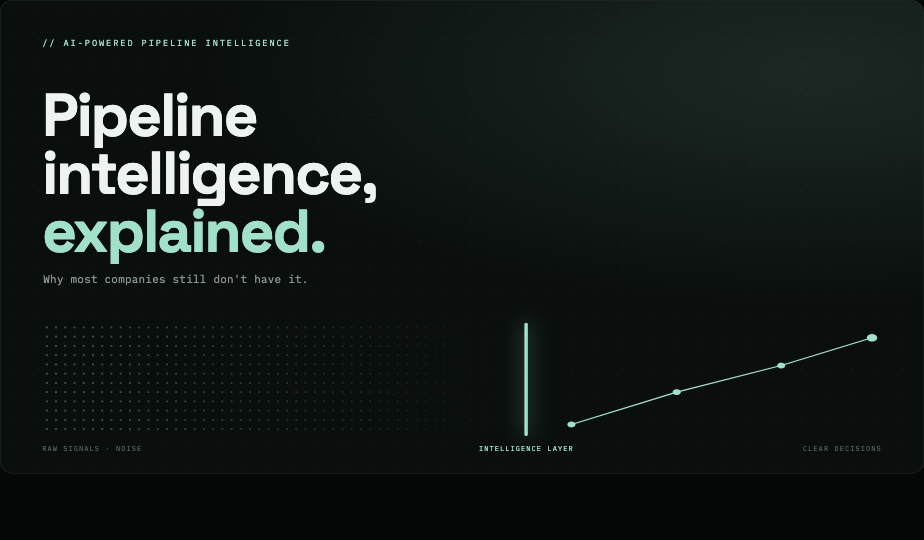
Every revenue leader wants better pipeline intelligence.
Organizations continue investing in CRM platforms, forecasting software, conversation intelligence tools, dashboards, and increasing AI tokens because they believe more information will lead to better decisions. The expectation is understandable. If every customer interaction can be captured, every opportunity tracked, and every forecast analyzed, the business should become more predictable.
Yet many organizations still struggle to answer some of the most important questions facing a revenue team. Which opportunities are genuinely healthy? Where is pipeline beginning to break down? Which deals are likely to stall before they appear in next month's forecast? More importantly, what should the organization do today to improve the outcome?
The challenge is rarely a lack of data. Most organizations have more information than they know how to use. What they often lack is a shared understanding of what that information actually means and how it should influence decisions across the business.
This is where the conversation around AI pipeline intelligence often becomes confusing. The term is used so broadly that it can describe everything from dashboards to forecasting software to conversation intelligence platforms. While each of those technologies provides value, they are not the same thing as pipeline intelligence. Treating them as interchangeable creates a false sense of maturity that leaves many organizations wondering why they still struggle with revenue predictability despite investing heavily in their technology stack.
"Most companies mistake activity visibility for pipeline intelligence."
Data Is Not the Same as Intelligence
One of the biggest misconceptions in revenue operations is the belief that collecting more data naturally leads to better decisions. It is an understandable assumption because modern go-to-market organizations generate an extraordinary amount of information. Customer interactions are recorded, emails are tracked, meetings are transcribed, opportunities are scored, and dashboards summarize performance across every stage of the funnel.
Despite that visibility, many leadership teams still rely on intuition when discussing forecast risk or pipeline health. It is common to see organizations with sophisticated reporting environments fall back on spreadsheets, side conversations, or a sales leader's instinct when making critical decisions. That disconnect highlights an important distinction. Visibility and intelligence are not the same thing.
Consider a familiar example. A dashboard tells you there are four million dollars in active pipeline. That information is useful because it provides visibility into the current state of the business. However, it does not explain which opportunities are genuinely healthy, which deals are beginning to lose momentum, or which accounts deserve immediate attention before the quarter slips away.
Analytics take that conversation one step further by identifying patterns inside the data. For example, historical analysis might reveal that opportunities without an executive sponsor or fewer than three active stakeholders close at significantly lower rates. That insight helps explain why deals succeed or fail, but it still requires someone to recognize the pattern, communicate it to the appropriate teams, and determine what actions should follow.
Intelligence begins where analytics end. It exists when those insights are synthesized, delivered to the people who can influence the outcome, and acted upon before the opportunity is won or lost. In other words, intelligence is not measured by the amount of information an organization collects. It is measured by whether that information changes decisions while there is still time to improve the result.
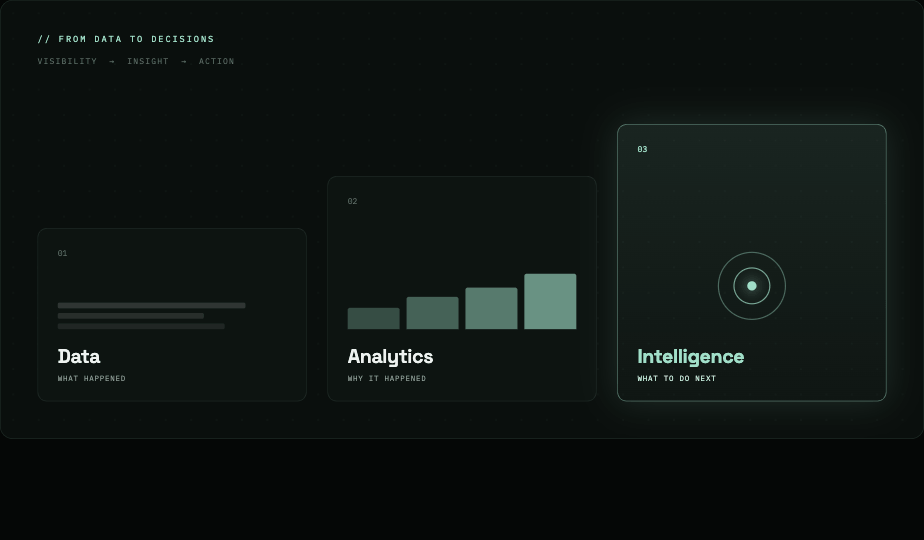
This distinction may seem subtle, but it fundamentally changes how organizations think about revenue predictability. Data helps explain what has happened. Analytics help explain why it happened. Intelligence helps determine what should happen next. As AI continues reshaping the way revenue organizations operate, that final step is becoming significantly more important than the first three combined.
How We Got Here: The Four Eras of Pipeline Intelligence
To understand why so many organizations are still searching for better pipeline intelligence, it helps to look at how revenue teams have historically managed pipeline information. While technology has evolved dramatically over the past two decades, the more significant shift has been the location of truth inside the organization. Each era has changed where teams look for answers, how they make decisions, and who has access to the information needed to move revenue forward.
Understanding those shifts provides important context for where AI pipeline intelligence fits today. It also explains why many organizations find themselves operating somewhere between traditional reporting and truly intelligent revenue operations, even after significant investments in technology.
Era One: Pipeline Lives in the Rep's Head
Every organization starts here.
In the earliest stages of a company, pipeline intelligence is largely built on experience and intuition. Opportunities live in the founder's memory, a salesperson's notebook, or perhaps a spreadsheet that everyone updates manually. Forecasting conversations revolve around questions like, "How does this deal feel?" or "What's your confidence level?"
For an early-stage company with only a handful of customers, this approach is often sufficient. There are relatively few opportunities to manage, everyone understands the customer base, and leadership has direct visibility into nearly every conversation. Formal systems would likely create more administrative work than operational value.
As the business grows, however, that approach becomes increasingly difficult to sustain. More accounts enter the pipeline, additional salespeople join the team, and leadership loses the ability to personally validate every opportunity. Information becomes fragmented because each individual develops their own interpretation of deal health, buying signals, and forecasting confidence.
Eventually, organizations reach a point where instinct is no longer enough. They need a shared place where pipeline can be documented, reviewed, and measured consistently. That need led to the second era of pipeline intelligence.
Era Two: The CRM Becomes the System of Record
The introduction of CRM platforms fundamentally changed revenue operations.
Whether the platform was Salesforce, HubSpot, Microsoft Dynamics, or another solution, the CRM created something organizations had never truly possessed before: a centralized record of customer relationships and sales activity. Pipeline no longer lived exclusively inside individual sales conversations. Leadership could review opportunities across the organization, standardize stages, and begin forecasting with far greater consistency.
This represented a significant operational advancement, but it also introduced a misconception that continues today.
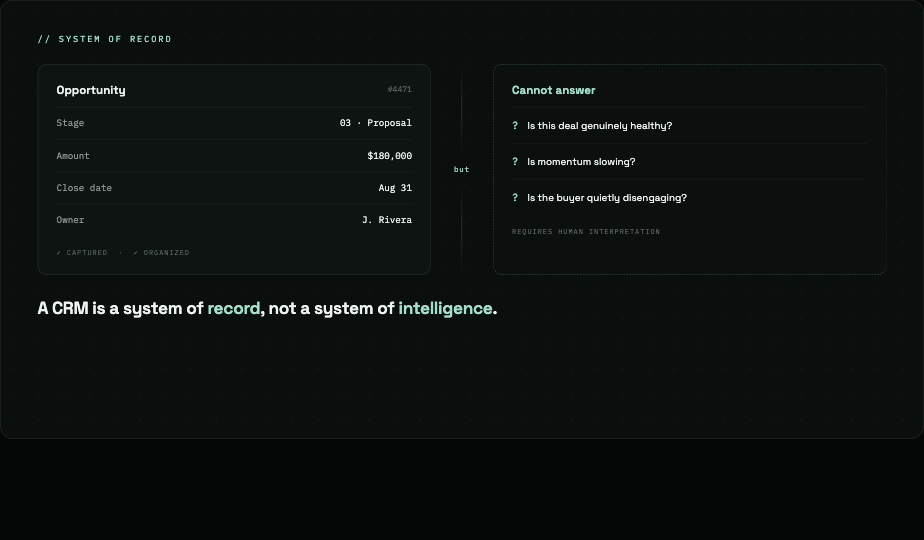
Many organizations began treating the CRM as though it were a system of intelligence. In reality, it has always been a system of record. Its primary purpose is to capture and organize information, not determine what that information means.
"A CRM is a system of record, not a system of intelligence."
A CRM can tell you that an opportunity is in Stage Three because someone updated the record. It can tell you the expected close date, deal value, and account owner because those fields have been completed. What it cannot reliably determine is whether the opportunity is genuinely healthy, whether momentum is slowing, or whether the customer is quietly disengaging despite what the stage suggests.
That distinction matters because organizations frequently expect answers from a system designed primarily to collect information. The CRM reflects what has been entered into it. It does not independently synthesize context, identify emerging risks, or recommend actions. Those responsibilities have traditionally remained with managers, sales leaders, and revenue operations teams.
As organizations accumulated more data inside their CRM, a new challenge emerged. They had access to more information than ever before, but they still struggled to understand what that information actually meant. This demand for greater visibility led to the third era.
Era Three: Dashboards Make Pipeline Visible
If the CRM created a centralized system of record, dashboards transformed that information into something leaders could finally explore and understand.
Business intelligence platforms, reporting tools, and visualization software made it possible to identify trends across thousands of opportunities rather than reviewing individual records one at a time. Revenue leaders could analyze conversion rates, compare pipeline by segment, evaluate sales velocity, and identify patterns that were previously impossible to see.
For many organizations, this felt like the arrival of true pipeline intelligence.
It wasn't.
Dashboards dramatically improved visibility, but visibility alone does not create intelligence. They explained what was happening inside the business and, in some cases, helped reveal why certain trends were occurring. They rarely influenced what happened next without significant manual effort from revenue teams.
Revenue Operations professionals know this reality well. Hours are often spent building sophisticated dashboards that summarize pipeline health, forecast accuracy, sales activity, and conversion metrics. Leadership reviews those reports during weekly meetings, discusses the results, and often leaves with the same unanswered questions they had before the meeting began.
Which deals deserve immediate attention?
Which accounts require executive involvement?
Which opportunities are quietly becoming forecast risks?
Where should Marketing, Sales, Customer Success, and Product focus their attention this week?
Traditional reporting rarely answers those questions automatically.
Instead, analysts and RevOps teams become responsible for interpreting the reports, synthesizing findings, and communicating recommendations across the organization. Intelligence exists, but it depends heavily on human interpretation and manual distribution.
Unfortunately, that creates a significant bottleneck. Valuable insights often remain inside weekly forecast meetings, Monday morning dashboards, or presentation decks that only a small group of leaders ever sees. By the time recommendations reach the people capable of changing the outcome, opportunities have frequently progressed beyond the point where intervention is most effective.
"A dashboard nobody acts on isn't intelligence. It's expensive wallpaper."
This is where many organizations remain today. They have exceptional reporting capabilities, extensive CRM data, and sophisticated analytics. Yet revenue predictability continues to depend on individual interpretation rather than shared operational intelligence.
The emergence of AI represents the next stage in that evolution, not because it replaces reporting, but because it fundamentally changes what happens after insights are generated.
Era Four: AI Transforms Pipeline Intelligence Into an Action Layer
The fourth era is where many organizations are trying to operate today, although relatively few have fully arrived.
Unlike previous eras, the biggest shift is not the introduction of another system. Most organizations already have a CRM, reporting tools, conversation intelligence platforms, and forecasting software. The real change is what AI enables organizations to do with the information they already possess.
For the first time, the cost of synthesizing large volumes of information has dropped dramatically. AI can review sales calls, emails, CRM updates, meeting notes, buying signals, and customer interactions in minutes rather than requiring a Revenue Operations team to manually piece those insights together over the course of a week.
Speed alone, however, is not what makes this era different.
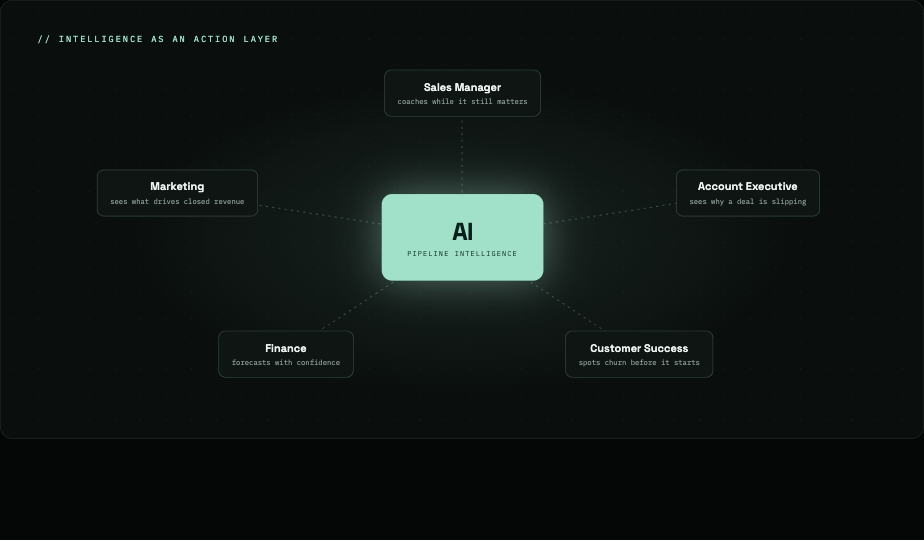
The real breakthrough is that intelligence no longer needs to remain inside a weekly forecast meeting or a Monday morning dashboard review. It can be distributed directly to the people capable of influencing the outcome.
An account executive can understand why a deal is losing momentum before it stalls. A sales manager can identify coaching opportunities while there is still time to improve execution. Marketing can recognize which messaging is contributing to closed revenue rather than simply generating leads. Customer Success can identify expansion opportunities and early churn indicators before customers disengage.
Rather than waiting for leadership to interpret reports and communicate next steps, intelligence becomes available across the revenue organization in near real time.
This represents a fundamental shift.
Pipeline intelligence is no longer something leadership reviews after the fact. It becomes an operational capability that supports better decisions throughout the customer lifecycle.
"AI doesn't just analyze pipeline. It distributes intelligence to the people who can act on it."
The Three Questions Real AI Pipeline Intelligence Should Answer
Many software vendors describe their products as intelligent because they provide dashboards, scores, or automated reports. Those capabilities are valuable, but they should not be confused with pipeline intelligence.
True AI pipeline intelligence helps organizations answer three questions with enough confidence and enough lead time to influence outcomes.
The first question is simple.
What is true right now?
This extends beyond pipeline totals or stage distribution. Organizations need an accurate understanding of current pipeline health, emerging risks, buying committee engagement, competitive pressure, and deal momentum. Without confidence in the present state of the business, every forecast becomes an exercise in interpretation rather than evidence.
The second question is equally important.
What happens if nothing changes?
This is where AI begins moving beyond traditional reporting. Rather than simply describing current conditions, intelligent systems can identify likely outcomes based on historical patterns and observed buyer behavior. Leadership gains visibility into future risk while opportunities are still active instead of discovering problems after the quarter closes.
The final question is the one that creates the greatest value.
What should we do today?
This is where intelligence separates itself from analytics.
Analytics explain patterns.
Intelligence recommends action.
It identifies which opportunities require executive involvement, where marketing should adjust messaging, which accounts deserve additional attention, and where customer success should proactively engage. Most importantly, it delivers those recommendations to the people capable of acting before the opportunity has been won or lost.
"Revenue predictability begins when intelligence changes decisions."
Revenue Predictability Is an Organizational Capability
One of the most significant misconceptions about pipeline intelligence is that it is primarily a sales function.
In reality, every revenue-generating team depends on understanding the same underlying truth.
Marketing needs visibility into which campaigns influence closed revenue rather than simply measuring lead volume. Finance needs confidence in forecast accuracy when making hiring and investment decisions. Product teams benefit from understanding which customer needs consistently appear in qualified opportunities. Customer Success requires early visibility into expansion potential and retention risk.
When intelligence becomes widely accessible, every function begins operating from the same understanding of customer behavior and pipeline health. Decisions become more aligned because they are informed by a shared source of truth rather than isolated reports or departmental metrics.
This is why revenue predictability should be viewed as an organizational capability rather than a sales metric. The more consistently information is synthesized, distributed, and acted upon across the business, the more predictable growth becomes.
Where Does Your Organization Operate Today?
Most organizations are not fully operating in a single era.
Many have a modern CRM and sophisticated dashboards while still relying on intuition to make forecasting decisions. Others have invested in AI tools but continue treating them as reporting platforms rather than operational intelligence systems.
The objective is not to adopt every new technology entering the market. It is to understand whether your current operating model allows intelligence to move efficiently throughout the organization. Technology becomes valuable when it helps people make better decisions together, not simply because it produces more information.
If your organization still depends on manual interpretation, isolated dashboards, or leadership intuition to understand pipeline health, there is an opportunity to move beyond visibility toward genuine intelligence.
The first step is understanding where you are today.
Our GTM Debt Assessment helps organizations evaluate the maturity of their go-to-market operating model, including the systems, processes, and intelligence capabilities that influence revenue predictability. Rather than measuring how much data you collect, it helps identify whether your organization is actually positioned to turn information into better decisions.
As AI continues reshaping revenue operations, the organizations that create lasting advantage will not necessarily be those with the most tools. They will be the organizations that consistently transform information into action.
That is ultimately what AI pipeline intelligence is designed to do.
Author

For weekly RVNU growth insights, subscribe to our Substack newsletter
Join over 2,000 subscribers!