
AI Won't Fix Broken GTM Systems
There is a conversation we're having with founders and revenue leaders almost every week with prospects. It usually starts with some version of the same question: "We're thinking about adding AI to our sales process. Where should we start?" Given the pace of innovation and the amount of attention AI is receiving, it's a completely reasonable question.
Organizations everywhere are exploring ways to use AI to improve efficiency, increase productivity, and scale growth. Teams are evaluating AI-integrated sales tools, layering automated workflows, improving forecasting, and looking for ways to streamline how work gets done across the customer journey. At the same time, found are facing pressure to move quickly as competitors adopt new technologies and expectations continue to evolve.
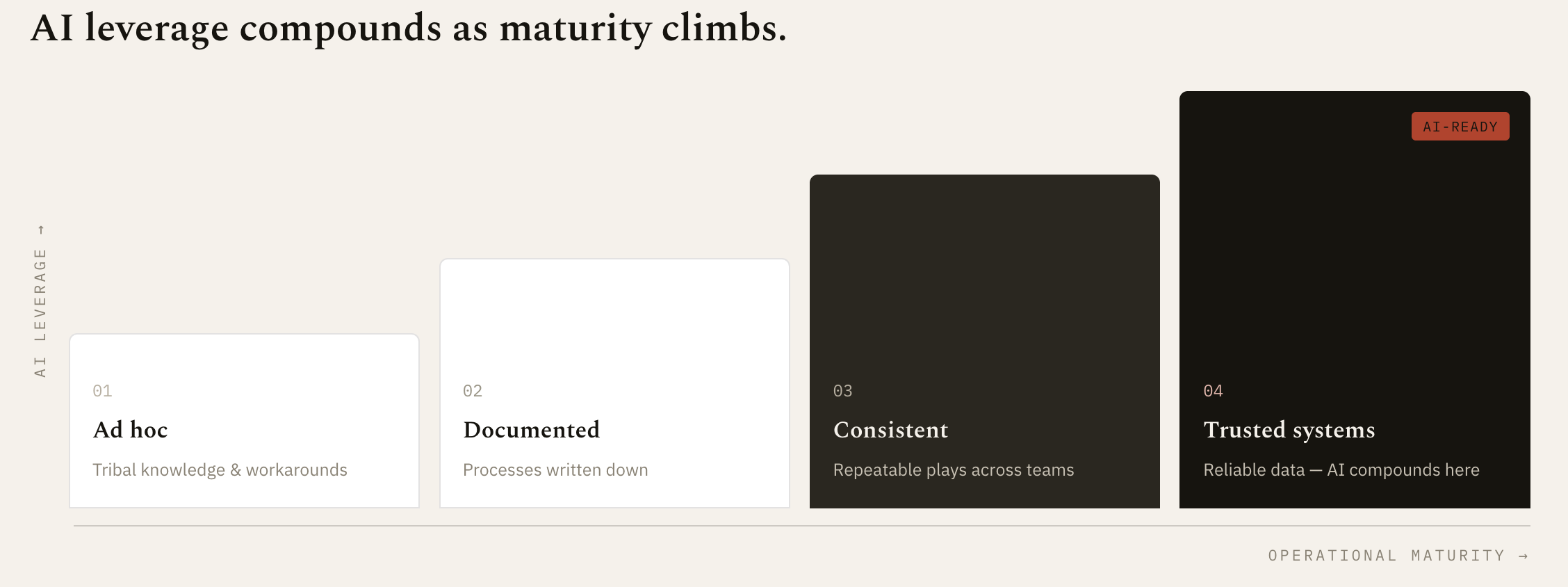
What we've found interesting, however, is that the organizations generating the most meaningful results from AI often have something in common before AI ever enters the picture. They typically have a clear foundational understanding of how their go-to-market system operates. Their processes are documented, their systems are trusted, and their teams operate with a level of consistency that allows technology to create leverage rather than confusion.
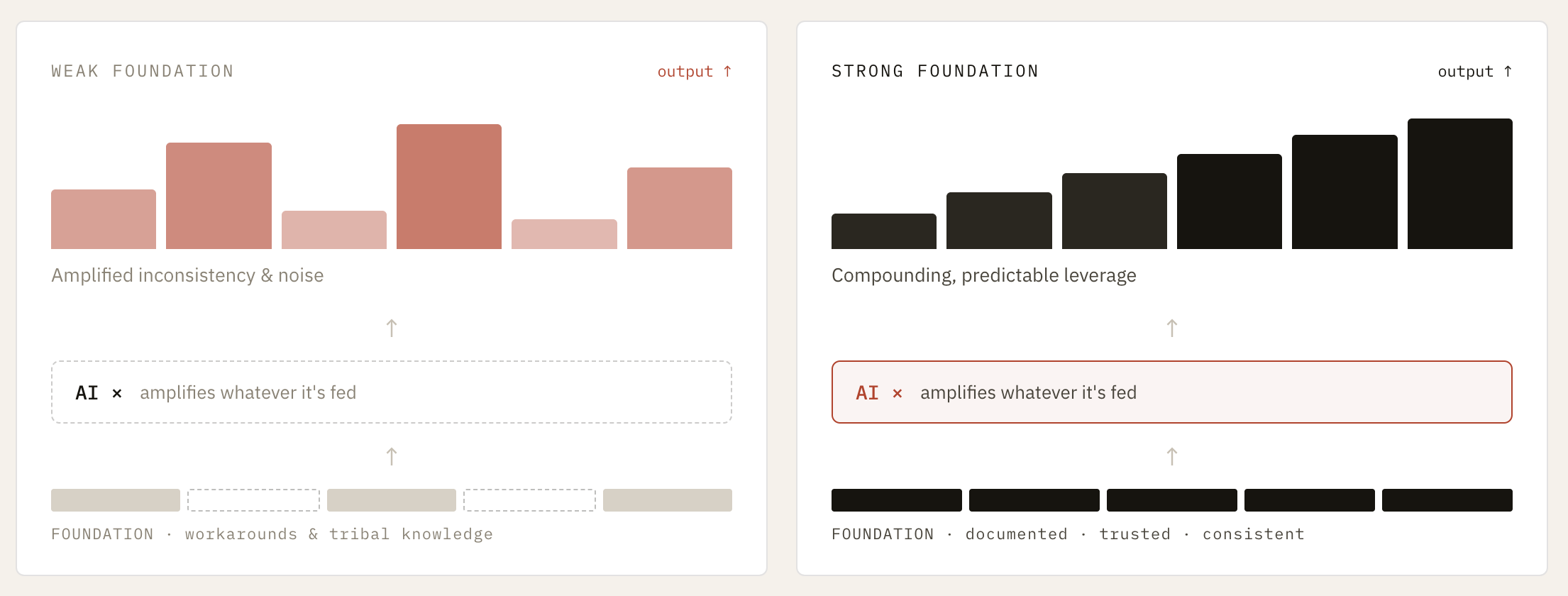
This observation has led us to think about AI a little differently. Rather than viewing AI as a solution to operational challenges, we've come to see it as something that amplifies the systems already in place. The stronger the foundation, the greater the leverage. The weaker the foundation, the more visible the gaps become.
AI doesn’t fix broken GTM systems. It amplifies them.
Why AI Is Creating a New Conversation About Operational Maturity
One of the reasons AI has become such a prominent topic is that it promises something every organization wants: efficiency. Revenue leaders want their teams spending more time on high-value activities. Founders want scalable growth without a proportional increase in cost. Organizations want better visibility, faster execution, and more predictable outcomes.
What often gets overlooked is that AI operates within existing systems. It relies on data, processes, workflows, and decision-making frameworks that already exist inside the organization. As a result, AI rarely functions as a standalone capability. Its effectiveness is directly influenced by the environment surrounding it.
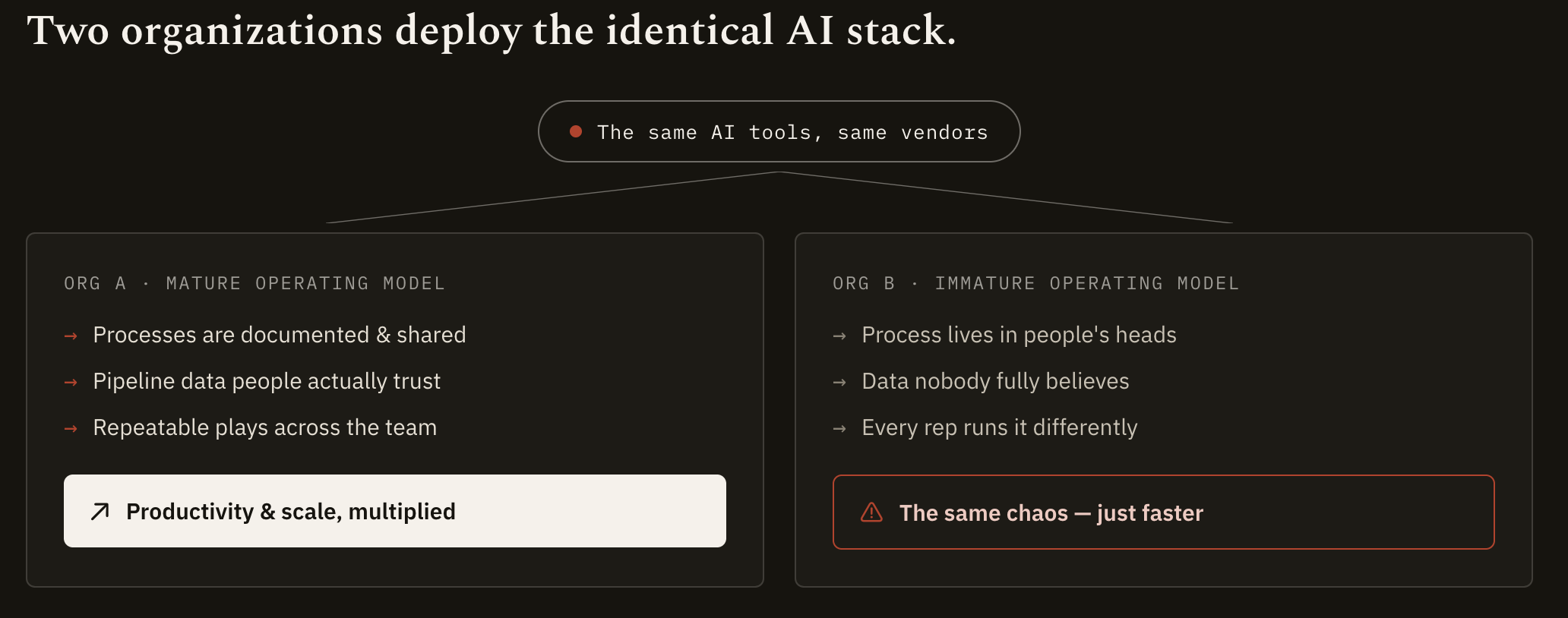
This is why two organizations can implement similar technologies and experience very different outcomes. One team may realize significant gains in productivity and scalability, while another struggles to generate meaningful impact. In many cases, the difference has less to do with the technology itself and more to do with the maturity of the operating model supporting it.
Operational maturity has always mattered. Organizations have always benefited from clear processes, aligned teams, reliable systems, and repeatable execution. What AI is doing is making the importance of those foundations much more visible. Areas that once relied on workarounds, tribal knowledge, or individual effort become increasingly difficult to scale when automation is introduced.
The Connection Between AI and Scalability
Many of the conversations around AI are ultimately conversations about scalability. Leaders are looking for ways to grow revenue more efficiently, support larger customer bases, and improve performance without endlessly increasing headcount. AI is often viewed as a path toward those outcomes.
The reality is that scalability has always been an experimentation challenge before it becomes a technology challenge. Organizations scale successfully when they create repeatable ways of working. They do this through experiments of gathering signal on what works and what doesn’t. Teams understand how opportunities move through the funnel. Processes can be executed consistently across individuals and departments. Information is accessible, trusted, and actionable.
When those conditions net a positive signal, technology can then create significant leverage. AI can accelerate analysis, support rapid decision-making, automate repetitive tasks, and help teams focus their efforts more effectively. The technology enhances an already functioning system.
When those conditions do not exist, however, technology often amplifies inconsistency. Different teams continue operating in silos. Data quality challenges remain. Handoffs continue to create friction. Visibility remains limited. The organization may move faster, but it is not necessarily moving more effectively.
This distinction matters because many organizations view AI as a catalyst for scalability when, in reality, scalability is often what enables organizations to realize value from AI in the first place.
Operational maturity creates the conditions where AI can generate leverage.
What We See in Organizations Successfully Adopting AI
One of the most interesting patterns emerging across revenue organizations is that successful AI adoption rarely begins with technology. It often begins with a deeper understanding of how the business operates today.
Leaders start by asking questions about process, alignment, and execution. They look for areas where teams rely on tribal knowledge. They identify friction points that slow down execution. They evaluate whether their systems provide reliable information and whether teams are working from a common understanding of success.
These conversations may not appear to be about AI on the surface, but they frequently determine the success of future AI initiatives. Organizations that understand their operating model are generally better equipped to identify where technology can create value. They know which activities are repeatable, which workflows are mature, and which processes are ready for automation.
This often results in a more strategic approach to AI adoption. Instead of searching for technology to solve every challenge, leaders begin identifying specific areas where technology can enhance an already defined process. The goal shifts from implementing AI to creating leverage through AI.
That distinction may seem subtle, but it fundamentally changes how organizations think about technology investments and expected outcomes.
Three Foundations of AI Readiness
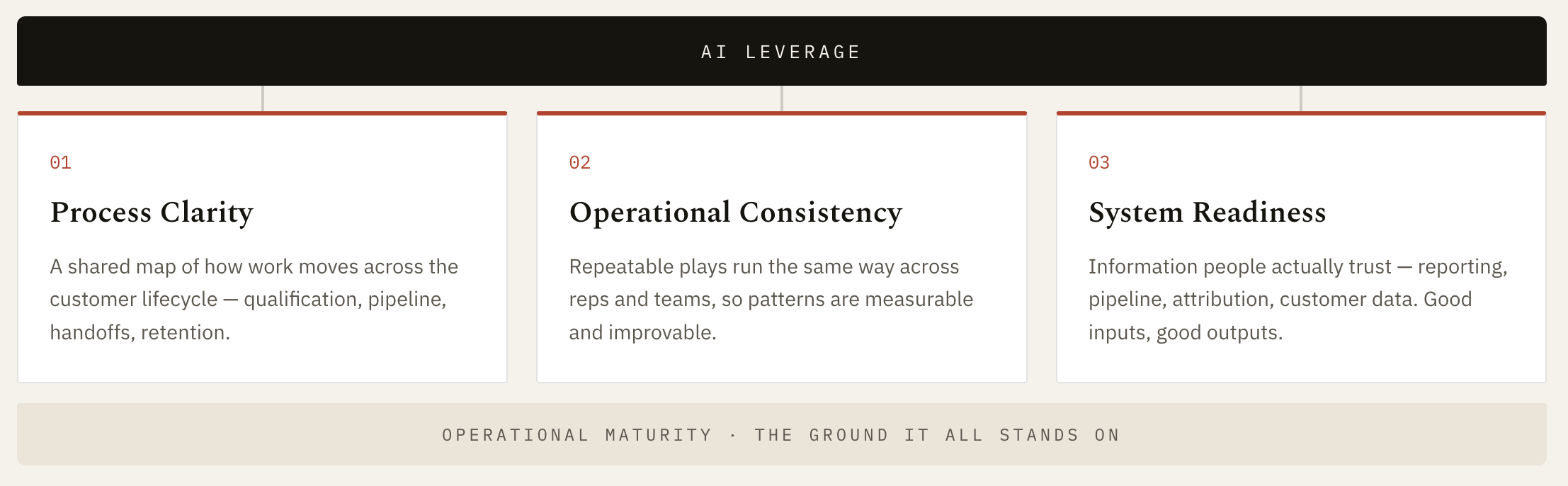
Although every organization is different, we consistently see three foundational characteristics in teams that are successfully integrating AI into their go-to-market motion.
Process Clarity
The first is process clarity. Teams need a shared understanding of how work gets done across the customer lifecycle. This includes how leads are qualified, how opportunities progress through the pipeline, how responsibilities are transferred between teams, and how customer relationships are managed after a deal closes.
The objective is not perfection. Most organizations are continuously refining their processes as they grow. What matters is that there is enough clarity for people to understand how the system is intended to operate and enough consistency for technology to support those activities effectively.
Without process clarity, automation can introduce additional complexity because different individuals are working from different assumptions. AI performs best when it is supporting a process that is already reasonably well understood.
Operational Consistency
The second foundation is operational consistency. High-performing organizations tend to run repeatable plays across their revenue teams. They create alignment around definitions, expectations, and execution standards. This consistency makes it easier to identify patterns, measure performance, and improve outcomes over time.
Consistency also creates the environment where AI can be most effective. When teams operate from a shared framework, technology can support decision-making and automate tasks with greater confidence. Patterns become easier to identify because the underlying processes are more predictable.
Organizations that lack consistency often struggle to realize the same benefits. When every team or individual approaches work differently, technology has a much more difficult time creating meaningful leverage.
System Readiness
The third foundation is system readiness. This is not simply a question of whether an organization has the right technology stack. It is a question of whether people trust the information inside their systems.
Can leaders trust reporting? Can sales teams trust pipeline data? Can marketing teams trust attribution? Can customer success teams trust customer information? These questions are often more important than the capabilities of any individual tool.
AI can process information faster than humans. It can identify patterns across large datasets and generate recommendations at scale. However, the quality of those outputs will always be influenced by the quality of the underlying inputs. Organizations that invest in system readiness position themselves to generate significantly greater value from AI over time.
AI tends to accelerate whatever GTM system already exists, good or bad.
Why GTM AI Strategy Is Really a Systems Conversation
Many discussions about GTM AI strategy focus on technology selection. Organizations evaluate platforms, compare features, and debate which tools will provide the greatest return on investment. While these conversations are important, they often happen before a more foundational conversation has taken place.
A GTM AI strategy is ultimately a systems conversation. It requires organizations to understand how information flows through the business, how decisions are made, where friction exists, and what conditions are necessary for scalable execution. Technology should support that understanding, not replace it.
This is why some of the most valuable questions organizations can ask have nothing to do with AI itself. Where does the process break down? Which workflows depend on tribal knowledge? Where is data least reliable? What activities would be difficult to automate because the underlying process is inconsistent?
The answers to those questions often reveal the highest-leverage opportunities for improvement. Sometimes those improvements involve AI. Sometimes they involve process redesign, better governance, or stronger operational alignment. More often than not, they involve a combination of all three.
The most effective GTM AI strategies begin with operational clarity, not technology selection.
Building a Foundation Worth Amplifying
There is no question that AI will continue to reshape how revenue organizations operate. The technology will improve, new use cases will emerge, and automation will become increasingly embedded throughout the customer journey. Organizations that learn how to leverage these capabilities effectively will create meaningful competitive advantages.
At the same time, we believe the most successful organizations will not be those chasing every new tool. They will be the organizations building systems capable of taking advantage of those tools when the opportunity is right. They will understand their processes, trust their systems, and create consistency across teams. They will treat technology as an amplifier of operational excellence rather than a substitute for it.
The conversation around AI often focuses on what the technology can do. From our perspective, the more important question is what kind of system the technology is being asked to support. Organizations that answer that question well are far more likely to create sustainable efficiency, scalability, and growth over the long term.
Ultimately, AI is not a shortcut to operational maturity. It is a multiplier for the maturity that already exists. That is why the strongest GTM AI strategies start with the foundation underneath the technology, not the technology itself.

Author

For weekly RVNU growth insights, subscribe to our Substack newsletter
Join over 2,000 subscribers!