
The Best GTM Consultant for Moving Upmarket to Enterprise SaaS (And Why Most Get It Wrong)
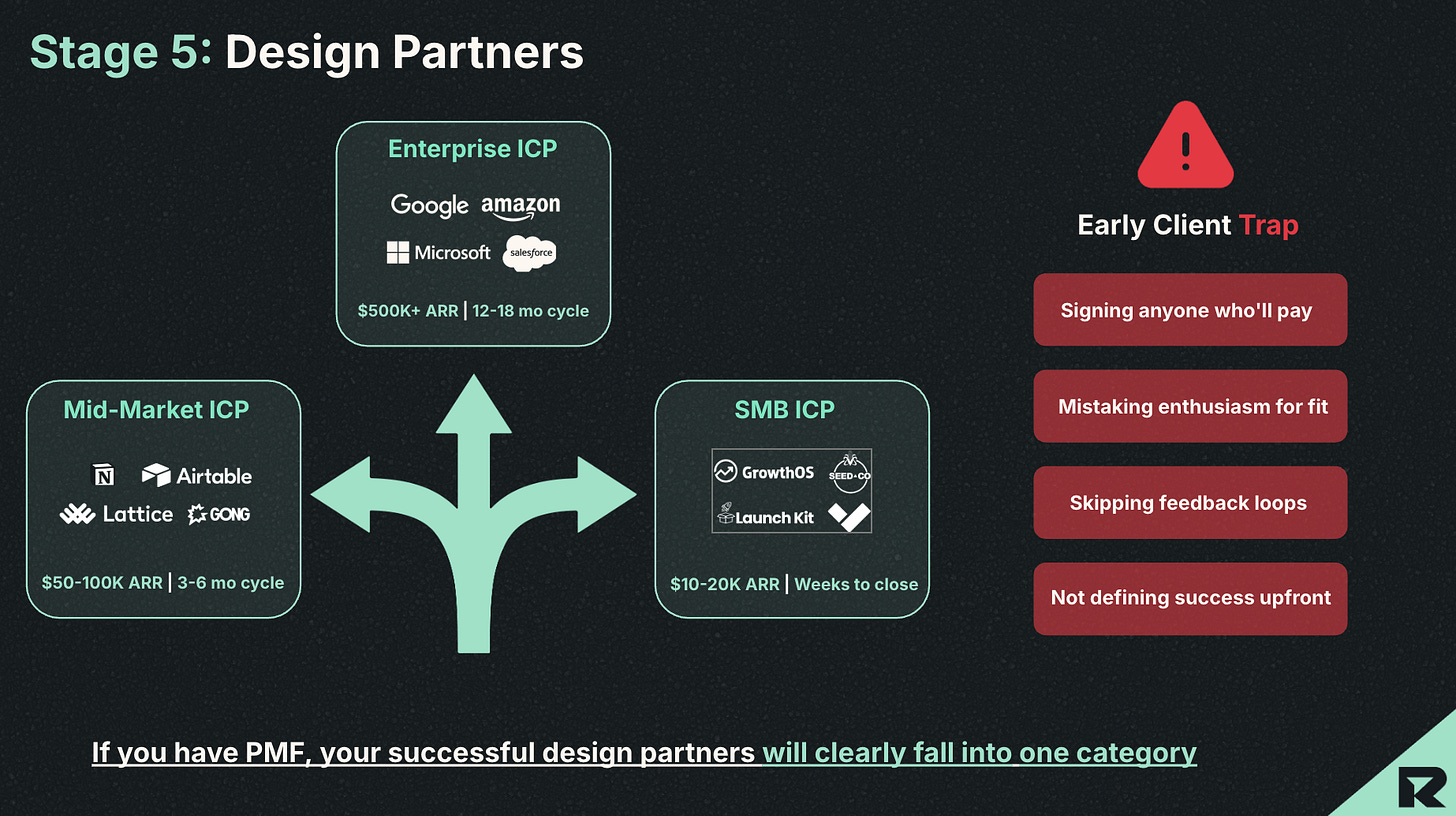
Most B2B SaaS companies that attempt to move upmarket fail. Not because the product can't serve enterprise buyers. Because the go-to-market wasn't rebuilt for a fundamentally different motion.
We talk to over 100 founders a year. The ones attempting an upmarket transition consistently underestimate what changes. They treat enterprise as a bigger version of mid-market. It isn't. And by the time they realize that, they've burned months of runway running an enterprise playbook that was never validated for the new segment.
This post breaks down what actually changes when you move upmarket, the levels of complexity most companies aren't prepared for, where the transition breaks in practice, and how to sequence the work so you're not rebuilding everything at once.
What Actually Changes When You Move Upmarket
Most founders think moving upmarket means selling the same product to bigger companies. It doesn't. Once your ACV crosses $50K+, the deal starts to path toward a strategic investment for the buyer. That changes the physics of how your GTM motion needs to function.
The buyer can't approve it alone. A committee forms. Finance wants ROI documentation. IT wants a security review. Procurement wants terms. A champion who loved your product three months ago is now one voice in a room of ten.
This isn't just a longer sales cycle. Mid-market deals are won on product fit and speed. Enterprise deals are won on organizational alignment, risk mitigation, and provable business impact. Your reps need to navigate buying committees, not impress individual users.
That single shift cascades through your entire operation. Your ICP needs to account for multiple personas. Your value story needs to land with a CFO, not just an end user. Your pricing needs to reflect quantifiable outcomes, and the growing pressure toward consumption-based models in AI-native products adds another variable. Your RevOps needs to track multi-threaded deals across months. Your customer success motion needs to protect accounts where churn means losing revenue and the reference that would have unlocked the next three logos.
These aren't separate upgrades. They're one system. Fix pricing without fixing the value story and deals still stall. Fix the sales process without fixing RevOps and you lose visibility into why.
The Levels of Complexity Most Companies Aren't Ready For
One reason upmarket transitions fail is that founders underestimate the jump in operational complexity.
A rep who can run an enterprise territory is not the same as someone who can design a territory model from scratch. A sales manager who can coach a team is not the same as someone who can build the hiring profile, compensation structure, and enablement program that makes the team function. These are different levels of work.
The same applies to your GTM operation. There are three levels, and most companies attempt the transition at the wrong one.
Level 1: Optimizing an existing motion. Better messaging. Better qualification. Tighter forecasting. This is where most GTM consultants operate. They're built to tune a working playbook. The problem is that if you're moving upmarket, there's no enterprise playbook to tune yet.
Level 2: Building a new motion from scratch. You're designing an enterprise GTM system that doesn't exist yet. New ICP definition. New sales process. New pricing architecture. New RevOps infrastructure. This is what moving upmarket actually requires.
Level 3: Managing the transition between motions. You're running mid-market and building enterprise simultaneously. Resources are shared. The team is stretched. The temptation to apply mid-market instincts to enterprise deals is constant. This is the level most Series A/B companies operate at, and it's the hardest because it requires holding two systems in your head at once while building one of them.
If you hire a GTM consultant or revenue leader who operates at Level 1, they'll optimize something that doesn't exist yet. If they operate at Level 2 but not Level 3, they'll build an enterprise motion that starves your mid-market revenue in the process. You need someone who understands all three and knows where you're actually at.
Where the Transition Breaks: Patterns Across 200+ Companies
After assessing 200+ B2B SaaS companies through our GTM Debt Assessment, the failure patterns in upmarket transitions are fairly consistent.
They skip ICP validation for the new segment. The most common mistake. Companies assume their mid-market ICP scales up. Often it doesn't. Enterprise buyers have different pain points, different buying processes, and different definitions of value. Without re-validating the ICP through enterprise Design Partners, every downstream decision is built on an assumption.
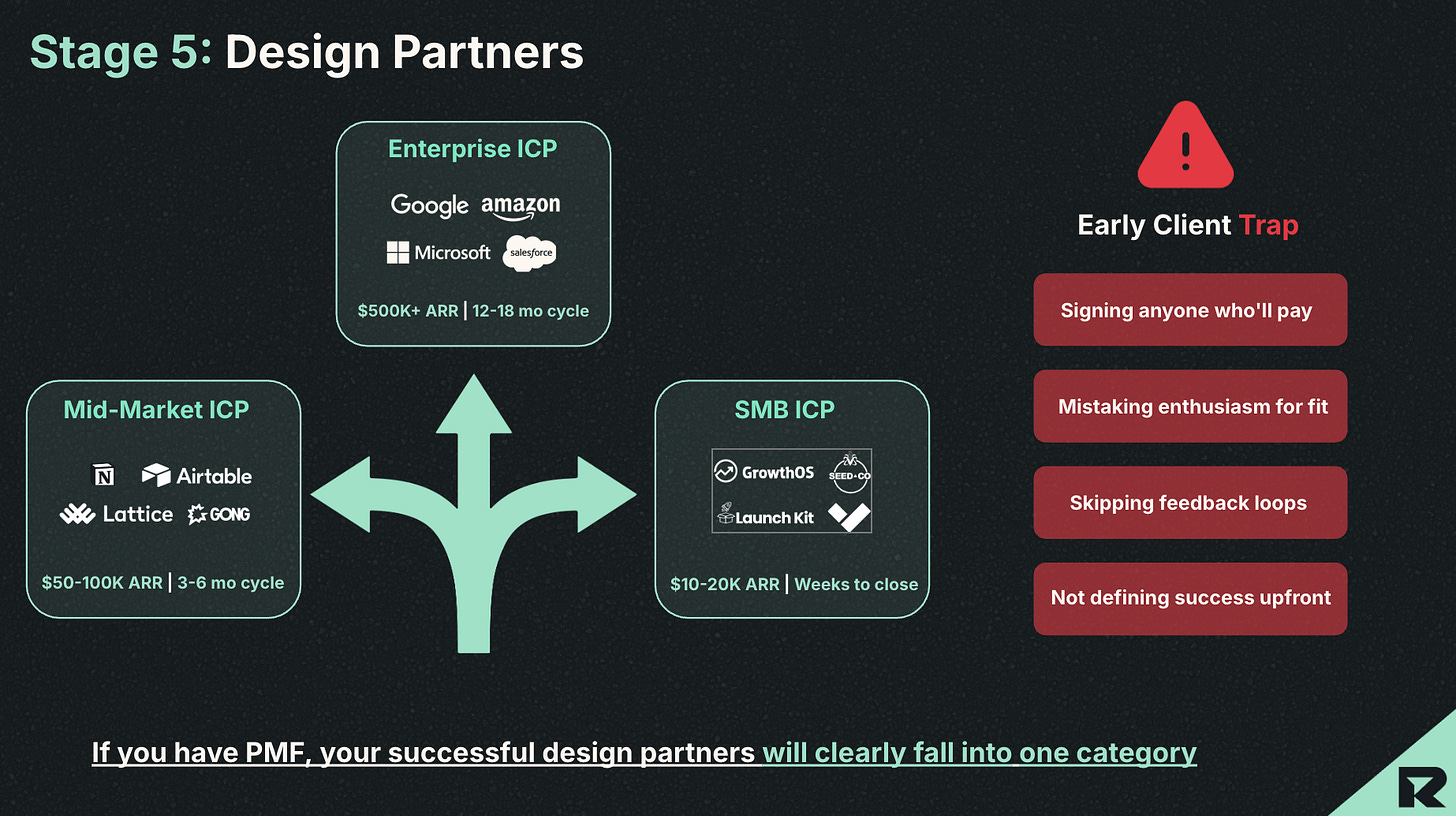
They can't prove value in enterprise terms. Mid-market value stories often focus on efficiency or ease of use. Enterprise buyers think in terms of strategic impact, risk reduction, and quantifiable ROI. If the value story hasn't been rebuilt for the enterprise buyer (Stage 7: Prove Value), deals die in committee because no one can justify the spend internally.
They hire enterprise reps before the playbook exists. Bridge Group's 2024 data shows median AE quota attainment at 51%. Putting enterprise reps into an unvalidated motion makes that number worse. The playbook needs to be documented at Stage 9: Repeatability before you hire against it.
They hire the wrong seller profile. Enterprise sellers and commodity sellers have fundamentally different DNA. Enterprise sellers navigate both high and low in organizations, engaging strategic influencers and end users while defending value-based pricing. Commodity sellers default to the lowest point of entry, focus on features, and compete on price. Hiring commodity sellers into an enterprise motion institutionalizes discounting.
They don't rebuild RevOps for the new motion. Enterprise pipeline management, forecasting, and deal inspection require different infrastructure than mid-market. Companies that run enterprise deals through a mid-market RevOps stack lose visibility and can't diagnose why deals stall.
They treat demand gen as a late-stage problem. Demand generation for enterprise starts at Stage 9: Repeatability and builds through the Go-to-Market Fit stages. If you can't generate enterprise pipeline repeatably before hiring enterprise reps, you're scaling a team into a lead famine.
Every one of these patterns creates GTM Debt in the enterprise segment. And unlike mid-market, where shorter cycles let you course-correct quickly, enterprise GTM Debt compounds over months because the feedback loop is so long. By the time you know an enterprise deal is lost, you've already invested a quarter or more in it.
How to Sequence the Work
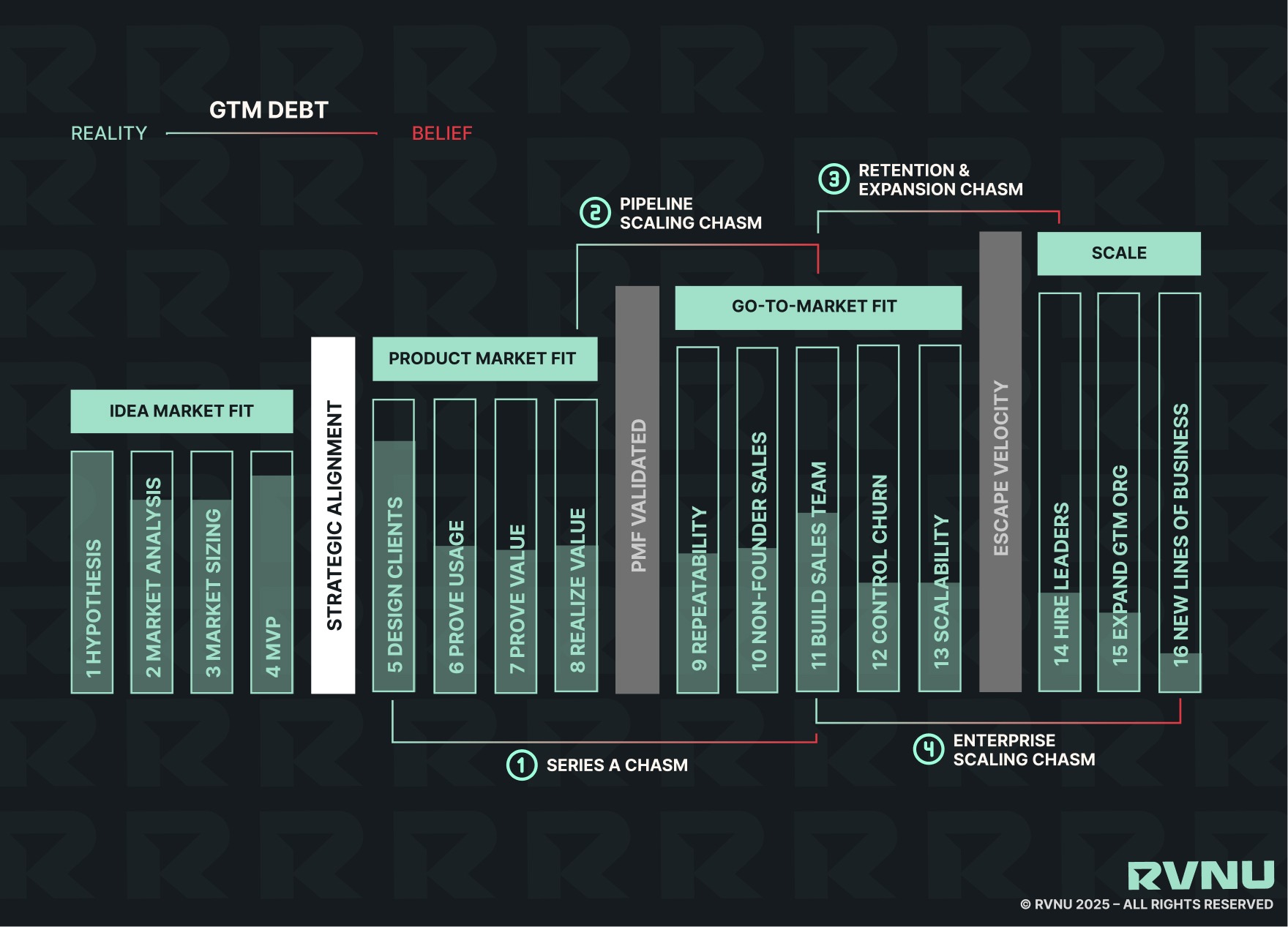
In our 16-stage GTM framework, moving upmarket is effectively launching a new line of business (Stage 16), which sends you back to Stage 1 for the enterprise segment. Nine stages require fresh validation. Seven can be inherited from your existing motion.
The correct sequence:
First: Re-validate the foundation. Stages 1-4 (Hypothesis through MVP). Is the enterprise market real? Does your product meet enterprise requirements? Security, compliance, integrations, SLAs. If there are gaps, address them before building a sales motion around a product that isn't enterprise-ready.
Second: Prove PMF for the enterprise segment. Stages 5-8 (Design Partners through Realize Value). Acquire enterprise design partners who fit the new ICP. Prove usage across all three buyer personas. Quantify value in dollar terms. Capture that value in pricing.
Third: Build repeatable GTM. Stages 9-13 (Repeatability through Scalability). Document the enterprise playbook. Validate that non-founders can sell it. Build the team with the right seller profiles. Control churn. Prove unit economics hold for the enterprise segment specifically.
Fourth: Scale. Stages 14-16 (Hire Leaders, Expand GTM Org, New Lines of Business). Only now do you hire senior enterprise leadership and scale the org.
The stages exist because the sequence matters.
What to Look For in a GTM Consultant for This Transition
They start with a diagnostic. They should be able to tell you which stages of enterprise validation you've completed and which you've skipped before recommending any action.
They operate at all three complexity levels. They can design a new motion, manage the transition from mid-market, and optimize once it's running.
They bring cross-functional capability. Revenue leadership, sales execution, and RevOps need to work together. A consultant who only brings one creates gaps.
They have enterprise buying experience. Navigating multi-stakeholder buying committees, procurement, and value-based pricing is a muscle that takes years to build. Startups don't have years. These hires have weeks to make an impact.
They sequence before they execute. They can articulate what happens first, second, and third, and explain why.
How RVNU Approaches This
RVNU works with B2B SaaS companies between $1M and $20M ARR. We combine revenue leadership, sales execution, and RevOps into a single system. We diagnose what's blocking growth and execute the scope to drive it.
Every engagement starts with the GTM Debt Assessment. We map where you actually are across all 16 stages, identify gaps in your enterprise validation, and build a sequenced plan based on what the data says.
We operate at two tiers: Advisory for strategic guidance and Co-Pilot for embedded fractional execution. Both are built to fix what's broken and build what's missing. The goal is to make RVNU unnecessary. We build the systems, document the playbooks, and transfer knowledge so your team owns it.
200+ B2B SaaS companies assessed. 18+ GTM engagements across software verticals. See how this works in our case studies.
Taking Action
Start with the diagnostic. Our GTM Debt Assessment at gtmdebt.com gives you an objective read on where you are across all 16 stages, including how ready you are for an enterprise transition.
FAQ
How long does an upmarket transition take?
If you're starting from scratch with a new enterprise ICP, expect 6-12 months on Stages 5 through 9 before the motion is repeatable. The timeline depends on deal cycle length and how quickly you can run validation cycles. Companies that try to compress this accumulate GTM Debt that surfaces as stalled deals, high churn, and failed hires.
Should I hire a GTM consultant or build the enterprise motion internally?
Start with the diagnostic. If your team has enterprise selling experience, validated the ICP, and documented the playbook, you may be ready to build internally. If the assessment surfaces gaps, outside expertise accelerates the work. Understand the problem first, then decide who solves it. Take the GTM Debt Assessment to get that read.
Can I run mid-market and enterprise simultaneously?
You can, but they're different systems requiring different playbooks, often different teams, and different RevOps infrastructure. That's Level 3 complexity. The framework is circular. Moving upmarket sends you back to Stage 1 for the enterprise segment. Nine stages require fresh validation. Seven can be inherited.
What's the biggest risk?
Accumulating GTM Debt in a new segment. Enterprise sales cycles are long. The feedback loop on whether your motion is working takes months, not weeks. By the time you know something is broken, you've invested a quarter or more running a flawed process. Building it right the first time is significantly cheaper than unwinding one that was built wrong.
Author

For weekly RVNU growth insights, subscribe to our Substack newsletter
Join over 2,000 subscribers!