
Your GTM Score

You took the RVNU GTM Debt assessment. You got your GTM (go-to-market) Score. Now you want to know one thing: is it good or bad?
That's the right question, however it has to be followed immediately by a second one: given my stage of growth, what should I do next, and in what order?
(Note: if you have not taken the RVNU GTM Debt Assessment, click here to take it now. It's free and takes 5 minutes to complete)
The score on its own is just a temperature read. The real value is in what it tells you to focus on, and the sequence to focus on it in. The diagnostic is built to give you confidence about where to focus and what to do next, in the right order.
This post breaks down:
- What the GTM score actually measures
- What a healthy GTM score looks like at your stage of growth
- The patterns that predict trouble regardless of where you sit
- How to use the diagnostic once you have your results
What the GTM Score Measures
Founders raise capital. VCs deploy it. Both sides operate on a loose agreement about what the next 12 to 18 months should produce. A Series A round, for example, typically comes with the implicit expectation of 3x ARR (annual recurring revenue) growth in the following year.
What rarely gets diligenced is whether the GTM foundation is actually in place to deliver that growth. Founders default to optimism about what they have built. Investors default to pattern-matching against past portfolio winners. Neither party has a structured way to assess whether the underlying machinery can deliver what's been promised.
The GTM score is the primary indicator of actual maturity rather than perceived maturity. The diagnostic determines whether the foundation can support the growth expected in the next stage. The score aligns interested parties objectively around the work that needs to be done, free from founder or investor bias, grounded in observations of where the foundation actually stands.
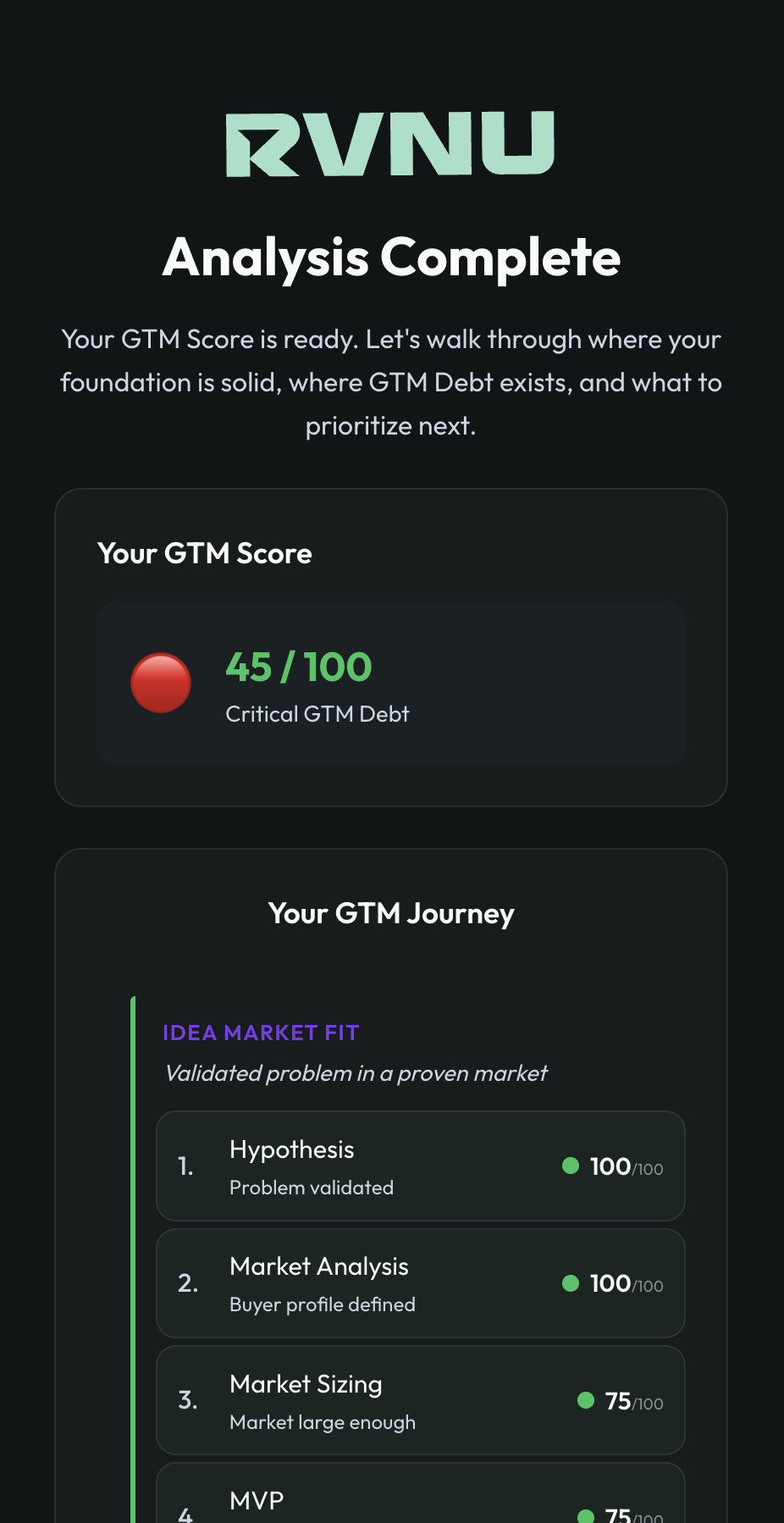
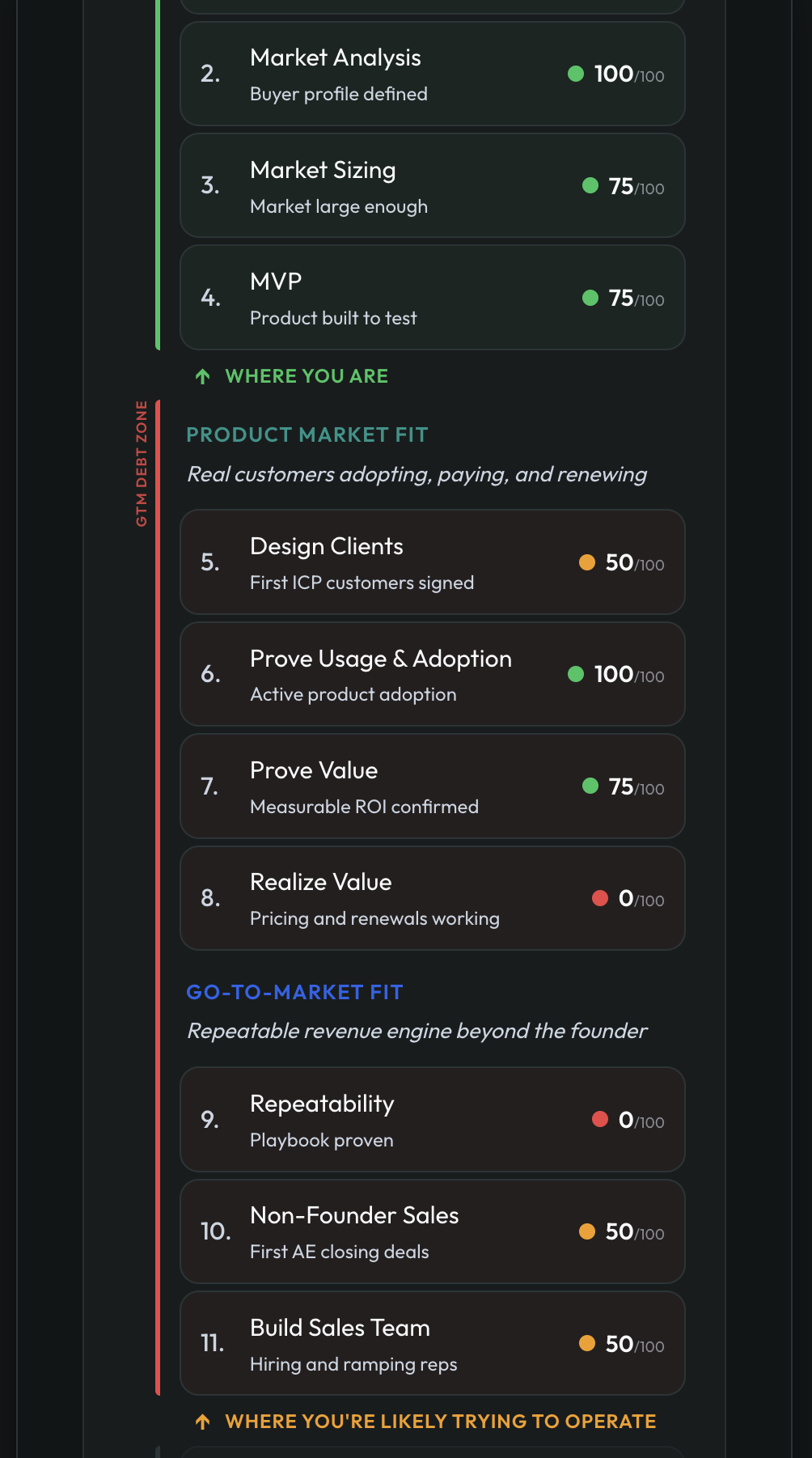
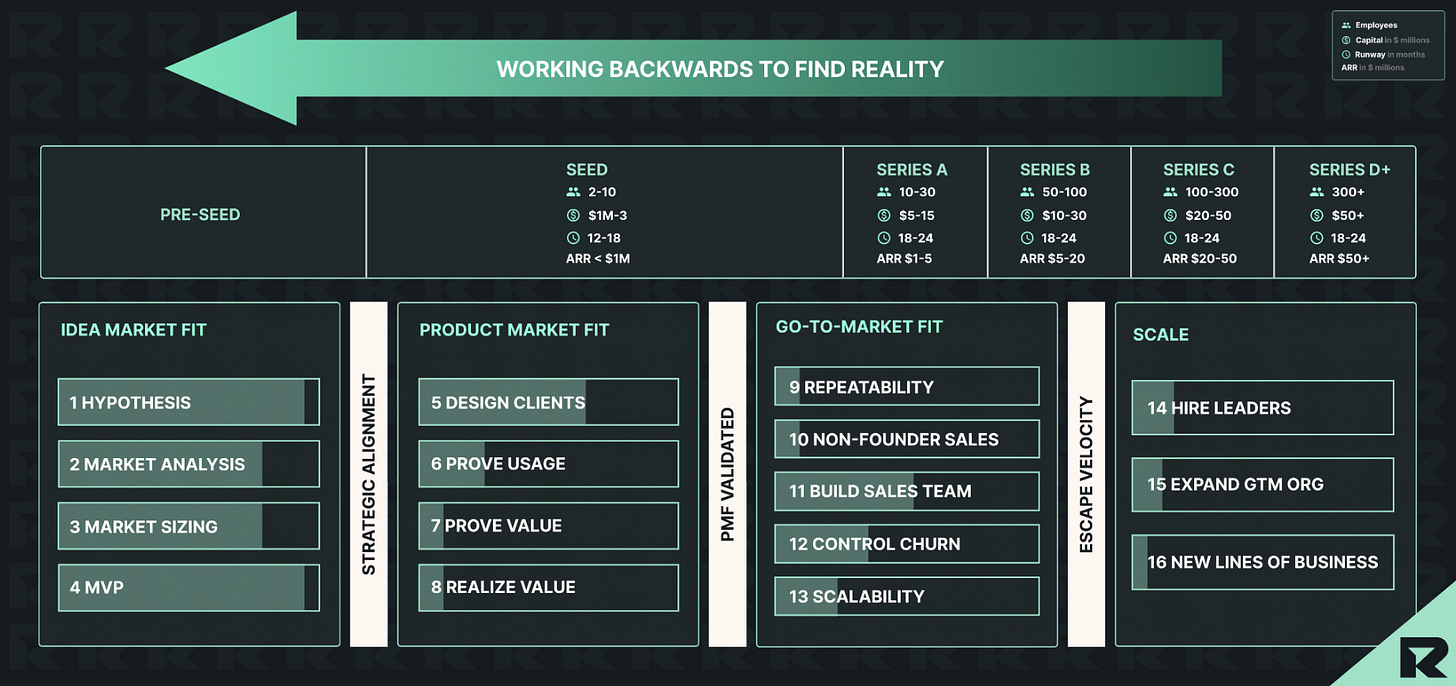
The mechanics: 16 stages, 4 phases (Idea Market Fit, Product Market Fit, Go-to-Market Fit, Scale), an aggregate score out of 100, and four phase scores. Traffic lights make it readable at a glance, with Green at 75+, Yellow at 50-74, and Red below 50. The full methodology lives at GTMscore.ai.
Why the Same Score Means Different Things at Different Stages of Growth
A score reads against a benchmark, and the benchmark is your stage of growth.
Stage of growth isn't just about ARR. It's about ARR plus the expectations that have been set on your behalf, whether through capital raised, time elapsed, or commitments made to investors, employees, or yourself. A founder at $200K ARR who raised $1M twelve months ago and posts a 38/100 is on track. A founder at $2M ARR who raised $10M a year ago and posts a 38/100 is in crisis. Same score. The GTM health reality, however, is completely different.
This is why the four phase scores matter more than the aggregate. Aggregate scores hide the shape of the foundation. Two companies can post the same 60/100 with completely different underlying profiles, and one is healthy while the other has a critical gap. The phase scores expose the shape, which is what actually tells you whether the next stage of growth is achievable.
.jpg)
What "Good" Looks Like By Growth Stage
Before reading the table: focus on the phase scores, not just the aggregate. The aggregate is the headline. The phase scores are the diagnostic. If you only look at one number, look at the phase score that matches the work you should currently be doing.
Each row uses ARR as the primary anchor, with capital context as the secondary variable. The funding stage labels are reference points for those who think in those terms, however the same ranges apply to bootstrapped and revenue-funded companies operating at the same scale.
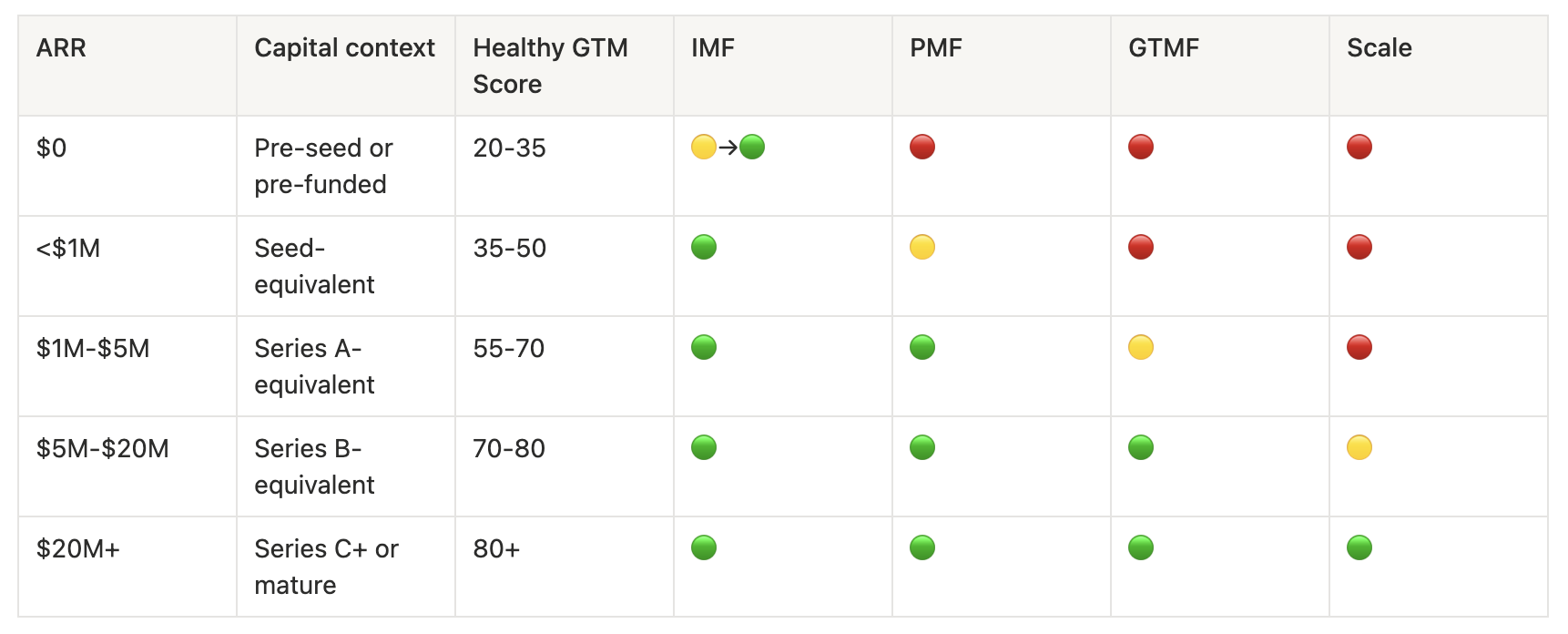
The numbers in the table are the headline. The detail in each section that follows is what you actually need to read against your situation.
$0 ARR, Earliest Stage: Healthy GTM Score 20-35
You have no revenue and a team of one or two. The only phase you should be active in is Idea Market Fit. Hypothesis (stage 1) and Market Analysis (stage 2) should both be tracking toward 75+. If those two pillars are below 50, you haven't earned the right to build yet, and any score you're posting on PMF (product market fit) or beyond is noise.
Under $1M ARR, Early Traction: Healthy GTM Score 35-50
IMF (Idea Market Fit)should be locked at 75+. PMF (Product Market Fit) should be emerging in the 50-74 range, with Design Clients (Stage 5) trending toward 75+ and Prove Usage (Stage 6) actively being built. This is the stage where founders most often confuse activity with progress. You have customers, they renew, it feels like PMF, however the score will tell you whether the middle pillars (Prove Usage and Prove Value) are actually validated or whether you're running on a handful of relationships that won't generalize.
$1M-$5M ARR, Scaling: Healthy GTM Score 55-70
PMF should be at 75+. GTMF (Go-to-Market Fit) should be in the 50-74 range and actively being built, especially Repeatability (Stage 9) and your first non-founder seller (Stage 10). This is the most important stage to read carefully. Roughly 80% of companies in this ARR band carry critical GTM Debt that's actively blocking growth. If your PMF score sits below 75 here, the growth expectations being placed on you weren't earned, and that's the problem to solve before anything else.
$5M-$20M ARR, Growth Phase: Healthy GTM Score 70-80
GTMF should be locked at 75+. Scale should be active, with Hire Leaders (Stage 14) as the first milestone in motion. This stage is the test of whether the GTM motion is actually a system or whether it's still founder heroics with a bigger headcount. Companies that hit this stage with GTMF still in the 50-74 range are running on the founder's personal involvement in deals, hires, and pipeline, and the cost shows up in the following 12 months as scaling stalls and hires churn.
$20M+ ARR, Mature Scale: Healthy GTM Score 80+
All four phases should be at 75+. At this stage the diagnostic is less about identifying foundational gaps and more about catching erosion. A phase score that drops into the 50-74 range after years above 75 means something has shifted, usually in the market, the ICP, or the competitive set. The score becomes an early warning system rather than a foundation check.
The Patterns That Predict Trouble Regardless of Stage
Three patterns to watch for, independent of where you sit.
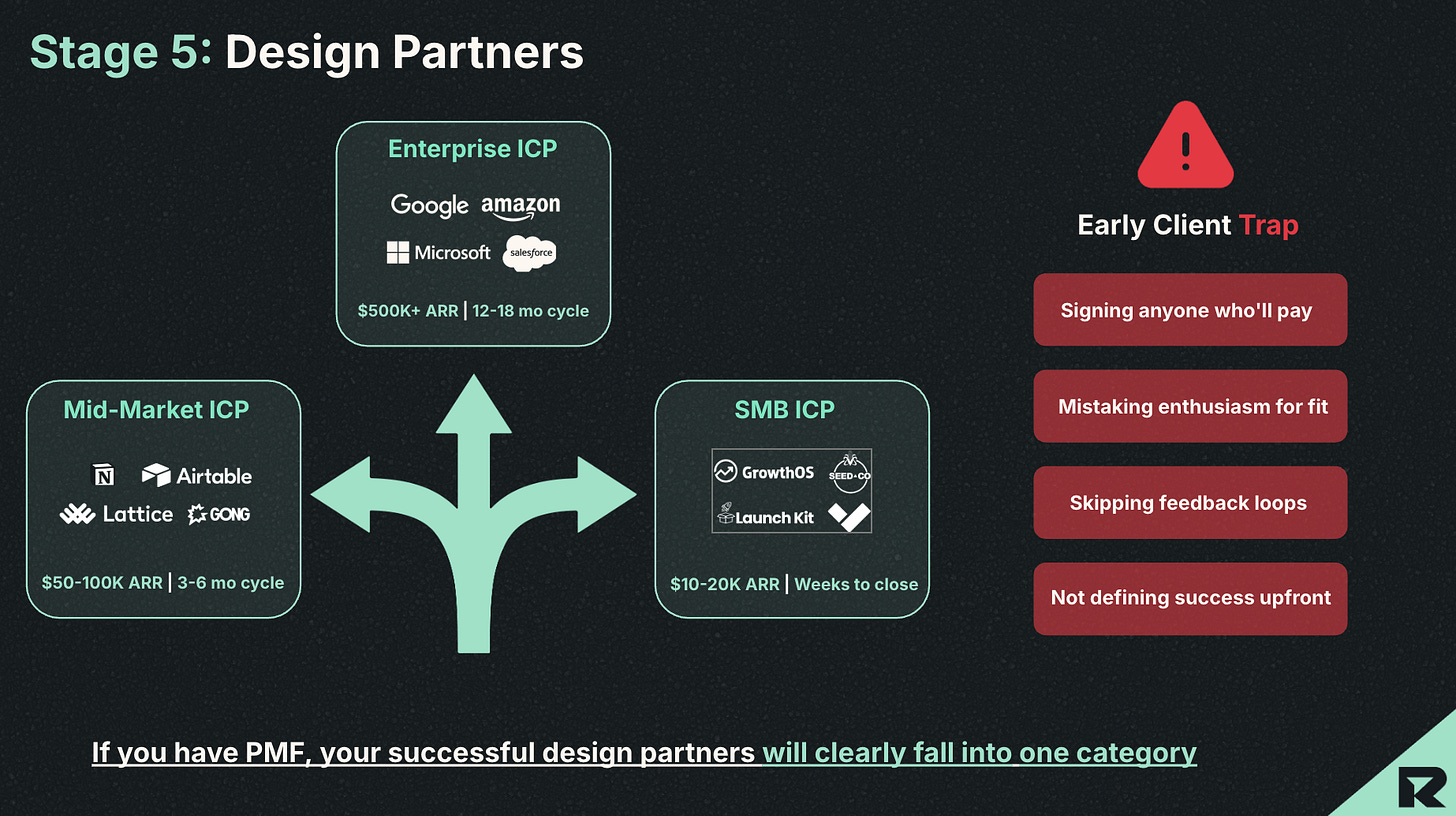
Foundation gaps under high GTMF scores. A company that scores above 75 on Build Sales Team (Stage 11) while sitting below 50 on Design Clients (Stage 5) is compounding debt fast. They're scaling a motion that was never validated. This is one of the most common failure modes we see, and the cost surfaces months later as quota attainment collapses and the founder can't figure out why.
The PMF Smile Curve. Across the dataset, founders consistently score lower on the middle PMF pillars than on the bookends. Roughly 8% pass Design Clients, 23 to 24% pass the middle PMF pillars (Prove Usage and Prove Value), and 11% pass Realize Value. The curve itself is the signal. Founders feel proximate to PMF because they have early customers and renewals, however the middle is hollow. The shape predicts where deals will start stalling once founder-led selling stops scaling.
Overconfidence as a research finding. Logically inconsistent answer combinations (high self-assessed phase, low underlying pillar scores) are surfaced rather than filtered. The score stays honest. The narrative names the gap. If you self-identify as operating at $5M+ ARR levels but your IMF is in the 50-74 range, the diagnostic doesn't punish you for it. It tells you what to revisit.
Where Most Companies Actually Sit: The $1M-$5M ARR Trap
Across 200+ companies assessed, roughly 80% of those in the $1M to $5M ARR band carry critical GTM Debt that's actively blocking growth.
The $1M to $5M band is where founder-led selling stops scaling and the cost of unresolved IMF and PMF debt becomes visible. The typical profile: one or two early sales hires showing some success, then stalling beyond that. The score reads PMF in the 50-74 range, GTMF below 50, however the company is operating like it's already at the next stage.
The diagnostic is a mirror. It shows the gap between where the founder thinks they are and where the foundation actually supports them.
How to Use Your GTM Score
Treat the aggregate as a temperature read. Treat the four phase scores as the diagnostic shape. Treat the narrative output as the prescription.
Don't optimize for the score, optimize the foundation. The score follows.
Re-take the assessment as you progress. The Lite version is designed to be re-taken quickly. The Full version functions as a living measurement tool inside a formal engagement with RVNU, updating as the foundation strengthens.
The score tells you that you have GTM Debt. The narrative tells you where it sits, why it's there, and what to do about it first. That sequencing is why I developed the diagnostic in the first place. Knowing what to fix first, in what order, is the difference between a year of compounding progress and a year of effort that doesn't move the needle.

Taking Action
The diagnostic matters more than the score. The score is the headline, however the phase shape and the narrative are the story.
Start at GTMscore.ai. Take the assessment. Read your results against the table in this post.
If you want help reading what comes back, book time with us through the link on the results page.
—-
FAQ
What's a "good" GTM score?
A score that matches your stage. A 50 for a seed-stage company under $1M ARR is healthy. A 50 for a company that's raised a Series B and sits at $10M ARR is likely a problem. The aggregate alone tells you almost nothing, however the phase shape against your stage and the expectations set by your capital tells you everything.
Should I be worried if my score is below 50?
A score below 50 means meaningful GTM Debt is blocking growth. Whether you should be worried depends on whether the debt sits in pillars you should have validated by now. A Scale phase score below 50 at $1M ARR with a seed round is expected. A PMF score below 50 at $5M ARR with $15M raised is a crisis, because the capital was deployed on the assumption that PMF was already locked.
Can a company score "too high" for their stage?
Yes, and it's one of the more useful signals. A pre-revenue founder with no capital raised posting a PMF score above 75 is almost always overconfident or misreading the questions. The same applies to a seed-stage company posting GTMF above 75 before they've hired their first seller. The narrative engine flags these. Overconfidence is preserved as a research finding rather than filtered out.
How often should I retake the assessment?
Every 3 to 6 months for the Lite version. The Full version is designed for continuous measurement once you're in an engagement.
Does the score account for industry or business model?
The framework is built for B2B software founders, however the underlying stages apply across SaaS, AI, infrastructure, and platform regardless of funding path. Industry context shows up in the narrative output rather than in the score itself. The operators at RVNU have experience across most tech sectors, from deep tech through to marketplaces. Check out our website for a deeper dive at RVNU.co
Author

For weekly RVNU growth insights, subscribe to our Substack newsletter
Join over 2,000 subscribers!