
What an AI-Native Revenue Architecture Looks Like

For more than a decade, organizations have approached revenue growth with a familiar playbook. When demand increased, they hired more salespeople. When reporting became difficult, they added another dashboard or analytics platform. When teams struggled with efficiency, they invested in automation to help employees complete more work in less time. Growth was largely viewed as a function of adding capacity, improving processes, and implementing better technology.
That model made sense for the environment in which it was created. Software primarily existed to support human execution, while organizational structures reflected the limitations of manual work. Marketing generated leads, Sales converted opportunities, Customer Success managed retention, and Revenue Operations connected the systems responsible for keeping information moving across the business. Technology accelerated execution, but people remained the primary drivers of every decision and every action.
Artificial intelligence changes that equation in ways many organizations are only beginning to understand.
Today, much of the conversation surrounding AI focuses on productivity. Leaders ask which tools can write emails, summarize meetings, automate outreach, or generate forecasts. Those are valuable use cases, but they all begin with the same assumption: the organization itself remains largely unchanged. AI simply becomes another layer added to an existing operating model.
That assumption deserves to be challenged.
The organizations creating lasting competitive advantages with AI are not simply adding new capabilities to existing workflows. They are reconsidering how work moves through the business in the first place. Rather than asking where AI fits into today's revenue process, they are asking what an entirely new revenue architecture should look like when intelligence becomes embedded throughout the operating model.
"The question isn't where AI fits into your revenue process. It's how your revenue architecture changes when AI becomes part of the operating model."
This distinction is subtle, but it fundamentally changes the conversation. Instead of viewing AI as another technology implementation, leaders begin treating it as an organizational design challenge. They stop asking how AI can help people perform existing tasks faster and begin asking how people, processes, systems, and data should interact when intelligence is available continuously across the organization.
That shift represents the beginning of what we believe is an AI-native revenue architecture.
Revenue Organizations Were Designed for an Earlier Era
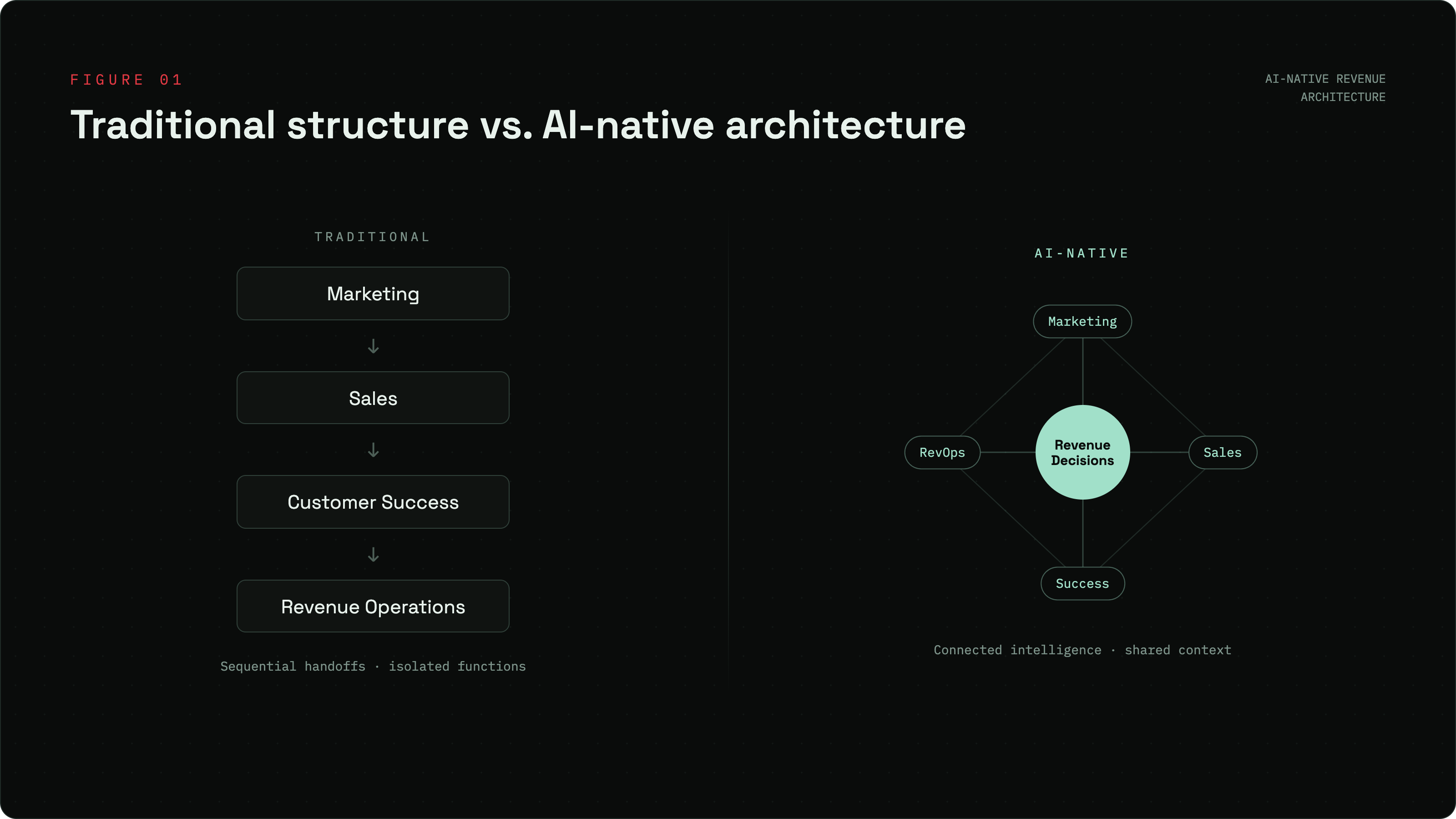
Nearly every modern revenue organization shares a similar structure. Marketing focuses on demand generation. Sales Development qualifies prospects. Account Executives manage opportunities. Customer Success drives adoption and expansion. Revenue Operations connects the systems and reporting that support each team. While responsibilities vary between organizations, the underlying architecture has remained remarkably consistent for years.
This structure was built around an important assumption: information moves slower than people.
Marketing collects data before handing prospects to Sales. Sales gathers additional context before updating the CRM. Revenue Operations consolidates information into reports that leadership reviews during weekly or monthly meetings. Decisions are made after humans collect, organize, interpret, and distribute information throughout the business.
For years, this model worked exceptionally well because people represented the primary constraint. Growth depended on increasing organizational capacity, improving operational discipline, and giving employees better tools to execute their responsibilities more efficiently. As businesses expanded, they added specialists to perform increasingly focused tasks while operations teams worked to connect everything together behind the scenes.
Many organizations continue approaching AI through this same lens.
Instead of questioning the architecture itself, they ask how AI can make each department more productive. Marketing experiments with AI-generated content. Sales teams automate prospecting emails. Customer Success summarizes conversations. Operations teams build AI-powered dashboards and forecasting models. Every function improves independently while the overall operating model remains unchanged.
Those improvements often deliver measurable efficiency gains, but they rarely address a larger question: what if the organization itself is still optimized for a world where information moves far slower than it does today?
The challenge isn't that these initiatives fail. It's that they frequently optimize an architecture designed around yesterday's constraints rather than tomorrow's opportunities.
"Automation without redesign simply helps outdated structures run faster."
Organizations often mistake automation for transformation. Automating repetitive work absolutely creates value, but automation alone does not eliminate fragmented decision-making, disconnected systems, or competing departmental priorities. Those problems originate from the architecture itself, not the speed at which individual tasks are completed.
This distinction becomes increasingly important because AI is changing more than productivity. It is changing the economics of information.
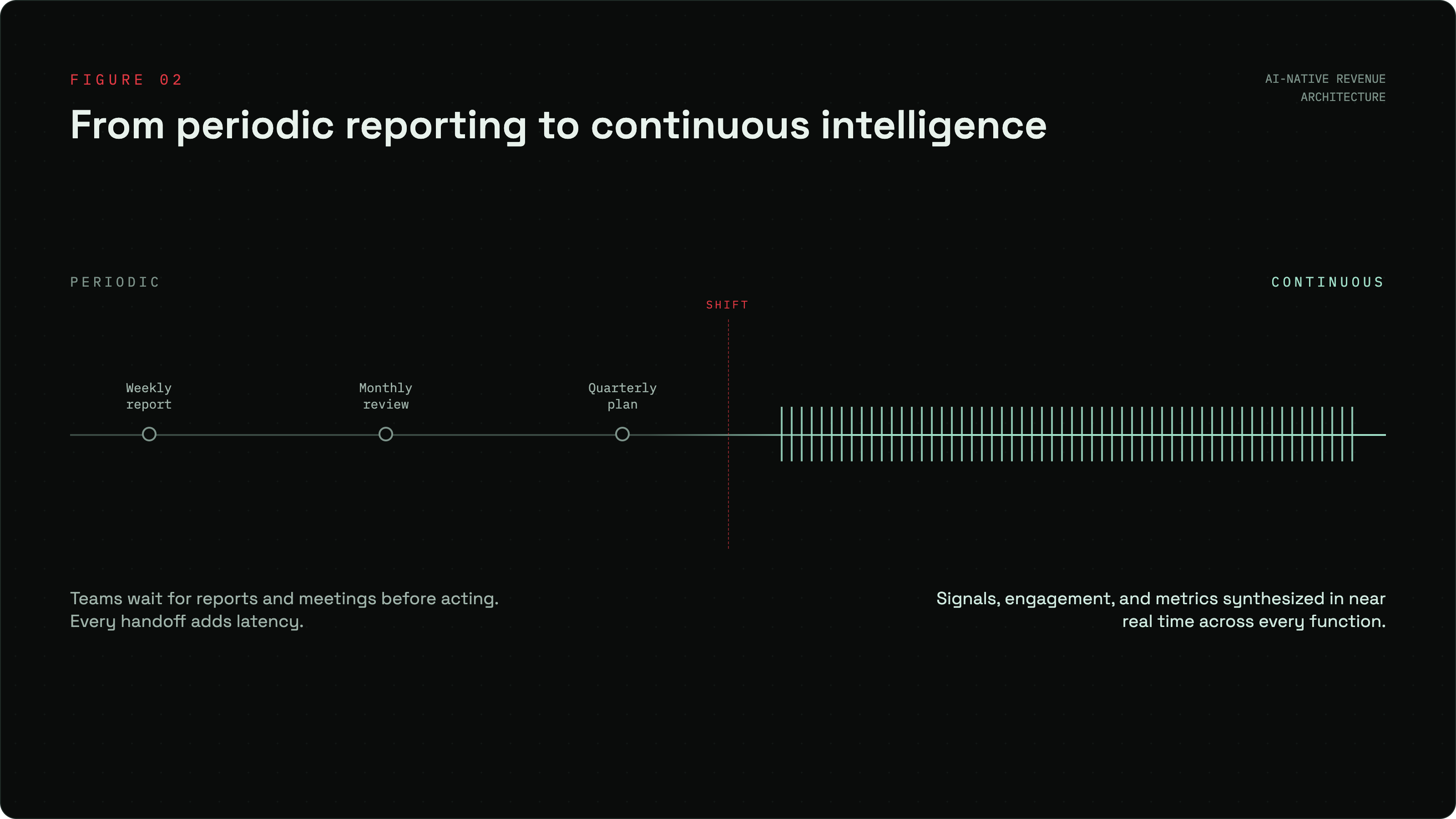
Activities that once required hours of manual analysis can now happen continuously. Signals that previously remained hidden across disconnected systems can be synthesized in seconds. Patterns that once required experienced operators to identify can increasingly be surfaced automatically. Intelligence no longer has to wait until the next meeting, the next report, or the next quarterly planning cycle before influencing business decisions.
When information begins moving continuously instead of periodically, the architecture built around periodic information flow begins to show its age.
AI Changes Organizational Design Before It Changes Productivity
One of the most common misconceptions surrounding AI is that its greatest impact will come from eliminating repetitive work. While automation certainly matters, history suggests that technological shifts rarely create their greatest value through productivity alone. Their lasting impact comes from changing how organizations are designed.
Consider the introduction of cloud computing. The technology did more than replace on-premise servers. It changed how software was developed, deployed, and purchased. Mobile technology similarly reshaped customer expectations rather than simply making existing applications available on smaller screens. The internet itself didn't just accelerate communication; it fundamentally transformed how businesses organized around information, distribution, and customer relationships.
Artificial intelligence represents another shift of that magnitude.
Organizations that treat AI as another productivity tool will certainly realize incremental gains. Employees will complete tasks more quickly. Reports will be generated faster. Forecasts may become more accurate. Those improvements matter, but they represent only the first stage of transformation.
The deeper opportunity emerges when leaders recognize that AI changes where decisions can be made, how information flows across functions, and what work should remain uniquely human. At that point, AI stops being a feature layered onto existing processes and becomes part of the operating model itself.
That realization forces leaders to rethink organizational design from the ground up.
"The future of revenue organizations won't be defined by how many tasks AI performs. It will be defined by how intelligently humans and AI make decisions together."
What an AI-Native Revenue Architecture Actually Looks Like
If AI changes organizational design before it changes productivity, then what should that new design actually look like?
The answer is not an organization with fewer people or significantly larger technology budgets. Nor is it an organization where every workflow is automated. Those assumptions continue to place technology at the center of the conversation when the real transformation is architectural.
An AI-native revenue architecture is built around the continuous movement of intelligence rather than the movement of tasks. Instead of asking which department owns each activity, leaders begin asking where information should flow, where decisions should occur, and where human judgment creates the greatest value.
That requires every component of the revenue organization to become more connected than ever before.
The most resilient operating models will no longer optimize individual functions independently. Instead, they will optimize the relationships between people, processes, data, systems, and AI. When these five components operate as a connected ecosystem rather than isolated capabilities, organizations become significantly more adaptive, responsive, and scalable.

People Become Decision Makers Instead of Task Managers
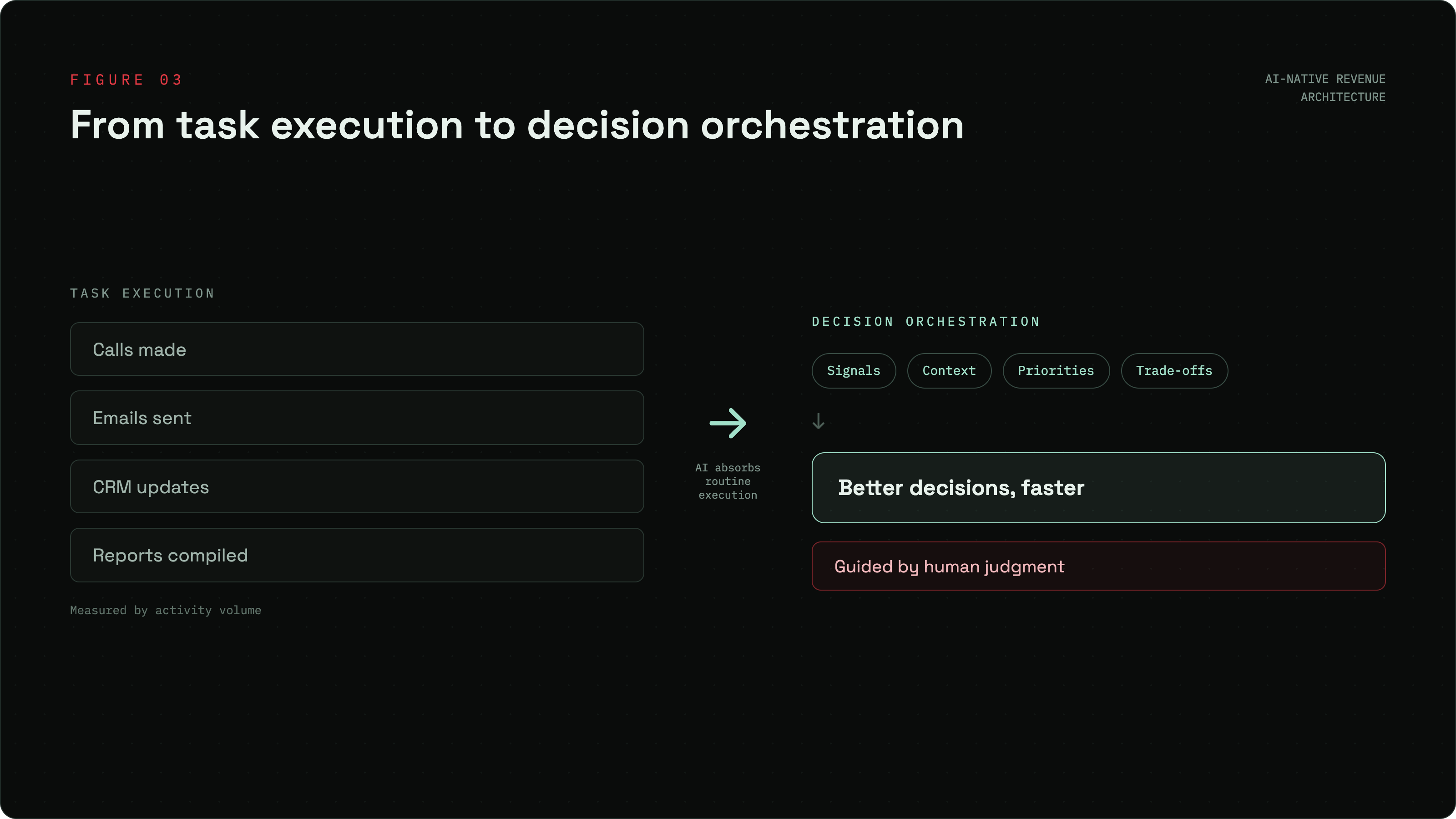
For years, revenue organizations have measured success by activity. Teams have been evaluated on the number of calls made, emails sent, meetings booked, opportunities created, or reports completed. Those activities remain important because they contribute to business outcomes, but activity itself is becoming less valuable as AI assumes responsibility for more routine work.
That does not diminish the importance of people. It elevates it.
As AI handles repetitive execution, the highest-value human contribution shifts toward judgment. Revenue leaders will spend less time gathering information and more time interpreting it. Sales representatives will devote less energy to administrative tasks and more attention to understanding customer priorities. Marketing teams will spend less time manually producing assets and more time shaping messaging, positioning, and strategy.
The organizations that benefit most from AI will not replace expertise. They will amplify it.
Rather than becoming managers of tasks, people increasingly become managers of decisions. Their role is to evaluate context, balance competing priorities, navigate ambiguity, and make choices that require experience, creativity, and trust. Those capabilities remain difficult to automate because they depend on human understanding rather than pattern recognition alone.
"AI doesn't eliminate human work. It changes where humans create the greatest value."
Organizations that recognize this shift early will redesign roles around decision quality instead of activity volume. Hiring profiles, performance expectations, and leadership development will naturally evolve as the skills that differentiate people become increasingly strategic rather than operational.
Process Evolves from Sequential to Continuous
Traditional revenue processes are designed as a sequence of handoffs.
Marketing generates demand before passing qualified prospects to Sales. Sales advances opportunities before Customer Success assumes responsibility for onboarding and retention. Each stage operates independently, with information flowing from one function to another as customers progress through the journey.
This model reflects an environment where information was gathered periodically and distributed manually. Teams waited for reports, meetings, and updates before adjusting their actions. Every handoff introduced delays because people needed time to collect, validate, and communicate new information.
An AI-native revenue architecture reduces that latency.
Instead of relying on scheduled updates, intelligence moves continuously throughout the organization. Customer engagement, buying signals, operational metrics, and market changes can be synthesized in near real time, allowing every function to operate with greater context. Marketing no longer waits to understand sales outcomes. Customer Success no longer depends solely on lagging indicators. Leadership no longer reviews performance weeks after decisions have already influenced results.
The process itself becomes adaptive rather than linear.
Instead of moving customers through predefined stages, organizations continually adjust based on emerging signals. AI supports that adaptability by identifying patterns faster than traditional reporting cycles, while humans determine the appropriate strategic response.

Data Becomes the Foundation Rather Than the Output
Many organizations continue treating data as the end product of operational activity.
Teams execute campaigns, conduct sales conversations, onboard customers, and eventually produce reports summarizing what happened. Data becomes something organizations review after work has already occurred.
That mindset made sense when collecting information was expensive and analysis required significant manual effort. Today, it creates unnecessary delays.
Within an AI-native revenue architecture, data is no longer viewed as historical documentation. It becomes the shared operating layer supporting every decision across the business.
Every customer interaction contributes to a broader understanding of buyer behavior. Every operational process generates signals that improve future decisions. Every department contributes to a common intelligence model rather than maintaining isolated datasets optimized for its own reporting needs.
This shift raises the importance of governance considerably.
Artificial intelligence is only as effective as the quality of the information supporting it. Organizations with fragmented systems, inconsistent definitions, duplicate records, and unreliable attribution will struggle regardless of which AI platform they adopt. Conversely, organizations that invest in clean data, consistent taxonomies, and well-designed operational processes create an environment where AI can generate meaningful insights instead of amplifying existing inaccuracies.
The conversation therefore shifts away from selecting the newest technology and toward strengthening the underlying data architecture that supports every business decision.
"Intelligence is only as reliable as the information it's built upon."
Systems Become an Integrated Operating Environment
Most organizations have accumulated technology over time rather than intentionally designing an ecosystem.
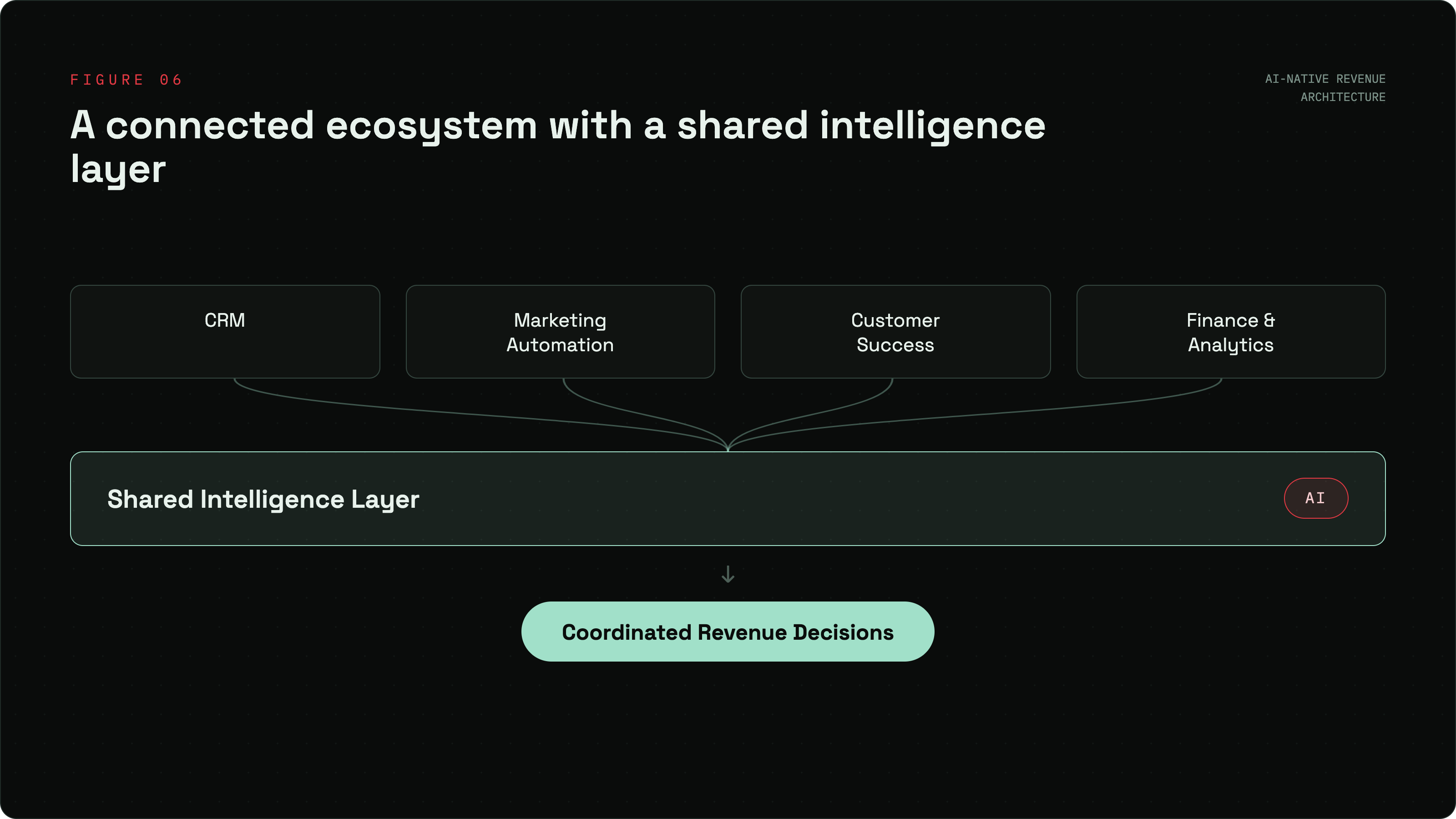
A CRM solves one challenge. A marketing automation platform addresses another. Sales engagement software, customer success tools, reporting platforms, conversation intelligence, and forecasting applications are added as new requirements emerge. Individually, each investment creates value. Collectively, however, they often produce fragmented workflows and disconnected information.
AI does not eliminate that complexity.
In many cases, it exposes it.
When intelligence depends upon information flowing seamlessly across systems, disconnected technology becomes significantly more problematic. Every missing integration, inconsistent field definition, or duplicate process limits AI's ability to generate accurate recommendations because its understanding of the business becomes incomplete.
An AI-native revenue architecture therefore treats systems differently.
Technology is no longer viewed as a collection of independent applications supporting separate teams. Instead, systems function as a unified operating environment responsible for continuously exchanging information, maintaining shared context, and supporting coordinated decision-making across the entire revenue organization.
The technology stack becomes less about the number of applications deployed and more about the quality of their connection.
AI Becomes an Organizational Capability
Perhaps the most significant shift is recognizing that AI itself should not be treated as another department or standalone initiative.
Too often organizations establish AI task forces, isolated innovation teams, or experimental pilot programs that remain disconnected from day-to-day operations. While these efforts generate valuable learning, they rarely produce lasting organizational transformation because AI remains separate from the operating model it is intended to improve.
Within an AI-native revenue architecture, AI becomes a capability that supports every function rather than belonging to any single function.
Marketing uses it to identify emerging demand patterns. Sales leverages it to prepare for customer conversations. Revenue Operations applies it to improve forecasting and operational visibility. Customer Success benefits from earlier identification of expansion opportunities and retention risks. Executives rely upon continuously synthesized intelligence instead of static historical reports.
AI is no longer the destination.
It becomes part of the infrastructure supporting better decisions throughout the organization.
"The organizations that outperform won't deploy more AI. They'll redesign how work moves."
Decision Orchestration Becomes the New Competitive Advantage
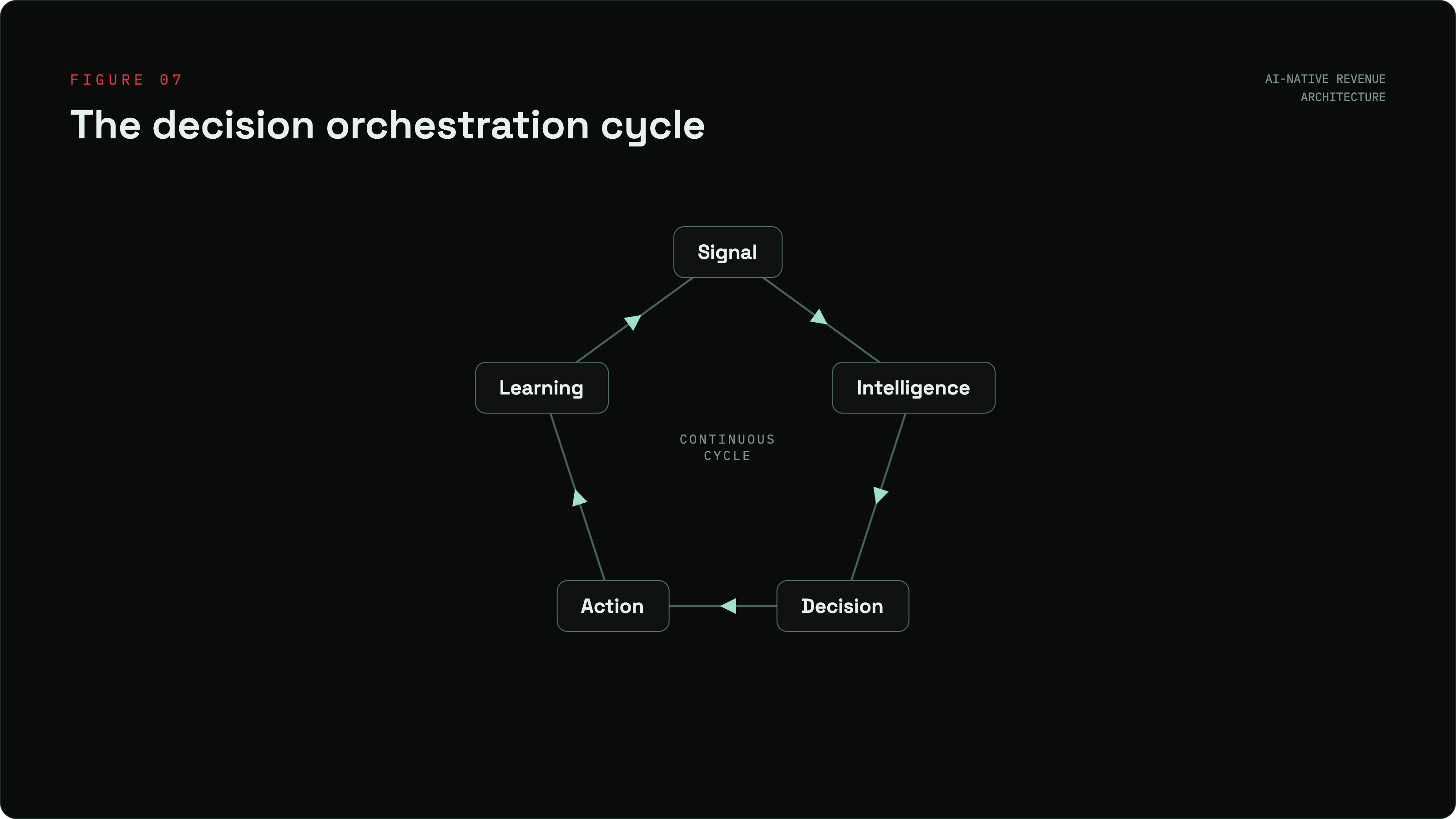
If the defining characteristic of traditional revenue organizations was efficient task execution, the defining characteristic of AI-native organizations will be effective decision orchestration.
Decision orchestration is the ability to continuously collect signals, synthesize information, determine the most appropriate action, and execute with the right balance of automation and human judgment. It represents a shift away from optimizing individual activities toward optimizing how decisions move throughout the organization.
Consider how many important revenue decisions occur every day. Which accounts deserve immediate attention? Which opportunities are most likely to close? Which customers show early signs of expansion or churn? Which campaigns are creating qualified demand rather than simply generating leads? Which investments deserve additional resources, and which should be reconsidered?
Historically, answering these questions required teams to manually gather information from multiple systems, interpret reports, compare competing priorities, and reach a conclusion. Even with sophisticated reporting, the process was often reactive because information reflected what had already happened rather than what was happening now.
An AI-native revenue architecture changes that dynamic.
Rather than waiting for information to be consolidated, organizations operate with continuously refreshed intelligence. AI identifies meaningful patterns across large volumes of structured and unstructured data, while people evaluate context, business priorities, customer relationships, and strategic trade-offs before determining the appropriate course of action.
The competitive advantage is no longer speed alone.
It is the ability to consistently make better decisions with better information.
Leadership Must Evolve Alongside the Operating Model
Technology rarely fails because it lacks capability. More often, transformation stalls because organizations continue leading with assumptions designed for an earlier operating model.
Many leadership teams still evaluate success through traditional measures of activity. More meetings. More outreach. More campaigns. More dashboards. While those metrics remain useful indicators, they become less meaningful if they fail to improve decision quality or business outcomes.
Leaders operating within an AI-native revenue architecture ask different questions.
Instead of asking whether teams completed more work, they ask whether the organization made better decisions. Instead of measuring the number of reports produced, they evaluate whether the right people received the right insights at the right time. Instead of celebrating efficiency alone, they focus on improving coordination across the entire revenue engine.
This shift requires a corresponding evolution in leadership.
Executives become architects rather than overseers. Their responsibility extends beyond managing departments to designing the environment in which people, technology, and intelligence operate together. That means investing in governance as intentionally as software, treating operational alignment as a strategic capability rather than an administrative function, and creating systems that allow information to move without unnecessary friction.
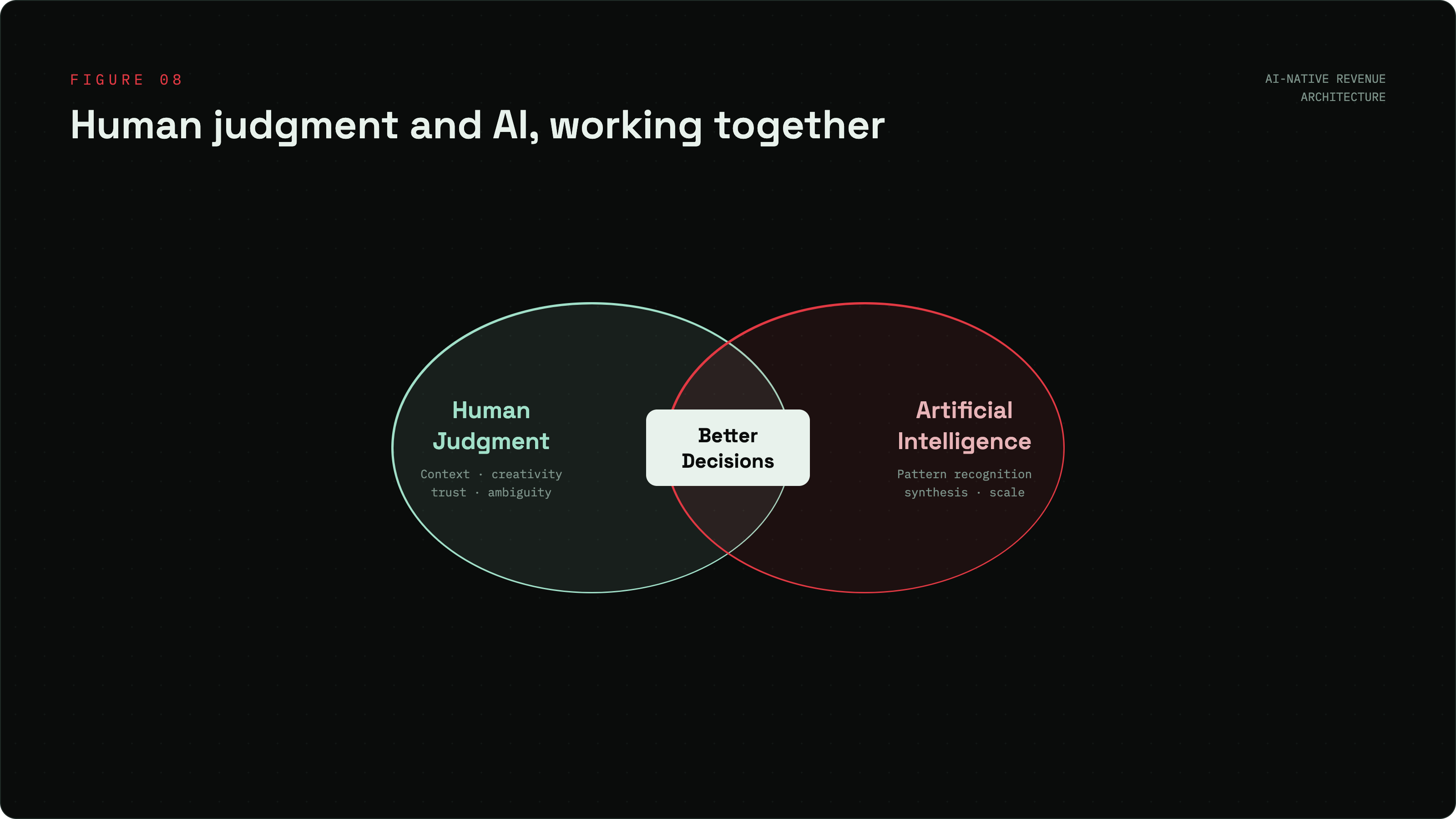
Leadership also becomes increasingly responsible for defining where human judgment should remain central. Not every decision should be delegated to AI, nor should every recommendation be accepted without question. Organizations that thrive will establish clear principles for balancing automation with experience, analytical insight with business intuition, and algorithmic recommendations with customer understanding.
"The future belongs to organizations that design for collaboration between human judgment and artificial intelligence, not competition between them."
Architecture Outlasts Technology
One of the easiest mistakes organizations can make is believing that becoming AI-native depends primarily on choosing the right platform.
History suggests otherwise.
Technology changes remarkably quickly. The tools dominating today's conversations will evolve. New models will emerge. Vendors will consolidate, differentiate, or disappear. Features that once represented competitive advantages eventually become expected capabilities.
Architecture lasts much longer.
Organizations that build strong operating principles are better positioned to adapt regardless of which technologies become available. Clean data, well-defined processes, aligned teams, shared operating metrics, and intentional governance continue creating value even as software evolves around them.
This is why architecture deserves more attention than tools.
A poorly designed operating model cannot be solved simply by introducing more automation. Likewise, a well-designed operating model can continue improving because it provides a stable foundation upon which new capabilities can be integrated over time.
The question therefore shifts from, Which AI platform should we implement? to something far more strategic:
What kind of revenue organization are we trying to build?
Answering that question first creates far greater long-term flexibility than selecting software before defining the operating model it is intended to support.
"Technology changes quickly. Architecture determines how well your organization adapts to that change."

Building the Revenue Organization of the Next Decade
Artificial intelligence is already changing how revenue organizations operate, but its greatest impact is unlikely to come from automating another workflow or accelerating another task. Its lasting influence will come from changing how organizations think about work itself.
As intelligence becomes continuously available, the barriers between departments begin to matter less than the quality of coordination between them. Information moves more freely. Decisions happen closer to the moment they are needed. Operational visibility improves because intelligence is no longer trapped within individual systems or functions.
Organizations designed around these principles will likely look different from those built over the past two decades. They will prioritize connected operating models over isolated departmental optimization. They will invest in governance alongside innovation. They will treat Revenue Operations not simply as a reporting function, but as an architectural discipline responsible for enabling alignment across the business.
Most importantly, they will recognize that AI is not the destination.
It is one component within a broader operating model that combines people, process, data, systems, and intelligence into a unified revenue architecture.
Organizations that understand this distinction are unlikely to ask where AI fits into the business. They will ask how the business itself should evolve because AI exists.
That shift in perspective is what ultimately separates AI adoption from AI transformation.
Conclusion

Much of today's conversation around artificial intelligence focuses on individual use cases. Organizations compare tools, automate repetitive tasks, and search for opportunities to improve productivity. Those initiatives create meaningful value, but they represent only one stage of a much larger transformation.
The organizations that create lasting competitive advantage will think beyond automation. They will redesign how information flows, how decisions are made, and how people and technology contribute together across the revenue organization. Instead of optimizing isolated functions, they will intentionally align people, process, data, systems, and AI into a connected operating model capable of adapting as technology continues to evolve.
"The future of revenue growth won't be built by adding more tools. It will be built by designing better systems for people and AI to create value together."
That is what we believe an AI-native revenue architecture represents.
It is not a technology strategy.
It is not an automation strategy.
It is an organizational strategy designed for a world where intelligence is no longer limited by the speed of human information processing.
The companies that thrive over the next decade will not necessarily be the ones that adopt AI first. They will be the ones that thoughtfully redesign how work moves, how decisions are made, and how value is created across the entire revenue organization.
Author

For weekly RVNU growth insights, subscribe to our Substack newsletter
Join over 2,000 subscribers!