
Best GTM Consultant for Enterprise PMF: How to Choose in 2026
Getting to Series A is tough. But here's what founders don't talk about at the celebration dinner.
The hardest part is just beginning.
I had a call last year with a founder who'd just closed their A. Good product. Strong early traction. They'd promised investors they had product-market fit and were ready to build a sales org.
Six months later, burn was running hot. The VP of Sales couldn't replicate what the founder had done. Pipeline looked healthy on paper. Revenue didn't convert.
The founder asked me: "Do we need hire the best GTM (go-to-market) consultant to establish product-market-fit (PMF) in the enterprise, or is the problem deeper than that?"
In most cases, it's the latter.
The Enterprise PMF Challenge: Why It's Different
Enterprise product-market fit isn't a bigger version of SMB (small to medium size business) or PLG (product led growth). It's a fundamentally different problem.
Complex Buying Dynamics
You're not selling to one user. You're navigating economic buyers, technical stakeholders, end users, and procurement. Enterprise deals involve multi-month cycles and buying committees that can stall or kill a deal at any point.
Higher Stakes
With $50K+ ACV (annual contract value) contracts, you need fewer customers to hit revenue goals. But each one must deliver real, measurable value. A single failed customer isn't noise. It's a valuable signal for you to act upon.
The Hidden Gap: PMF vs GTM Fit
Most founders believe they've "achieved PMF." In reality, they're still validating who the real ICP (ideal customer profile) is, whether usage is consistent, whether value is repeatable, and whether that value translates into revenue.
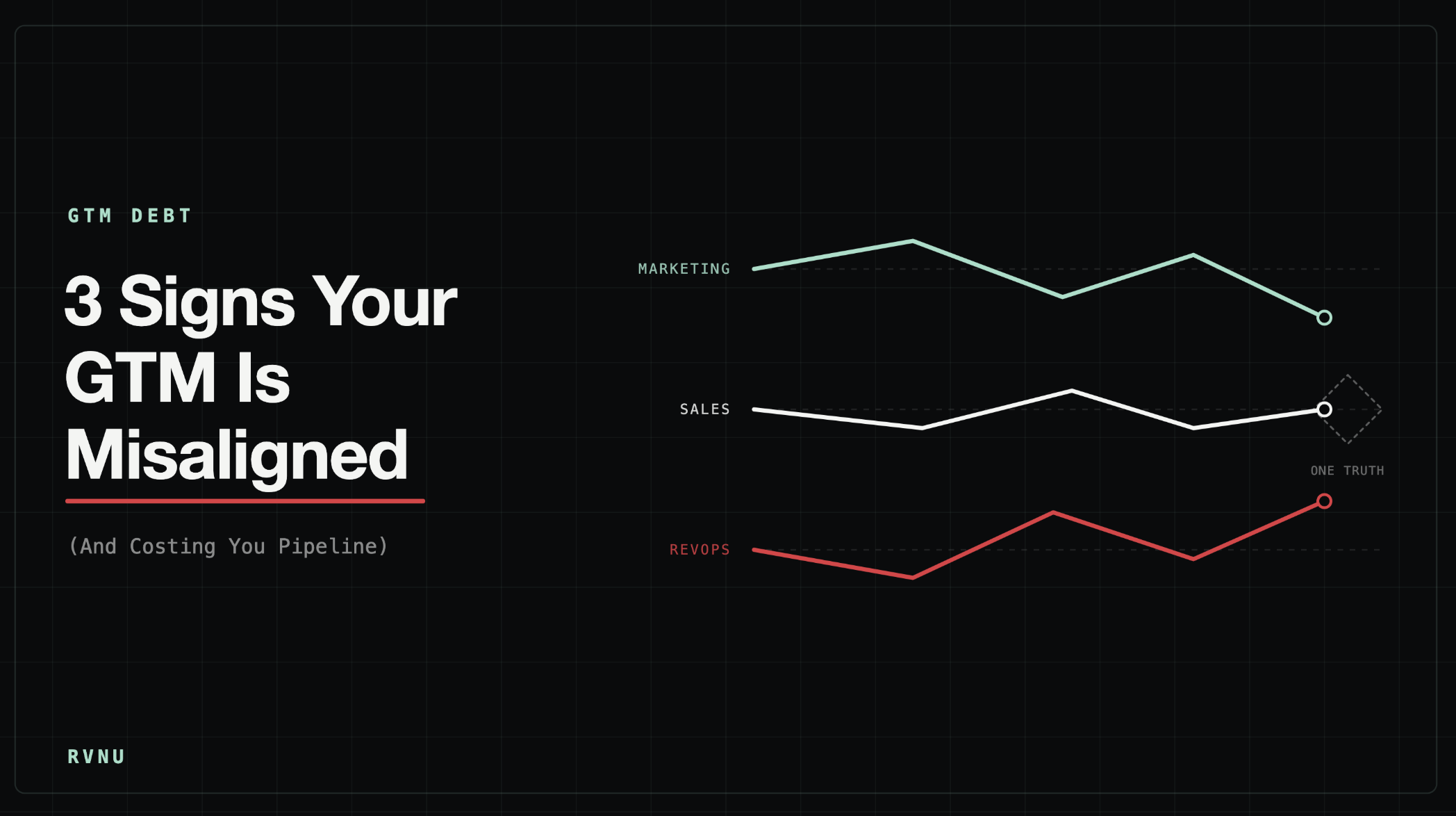
This gap is what we call GTM Debt: the compounding cost of skipped validation steps, premature hires, and undocumented processes that accumulate interest over time. Every shortcut compounds. And by the time you feel the drag, the cost of fixing it has multiplied.
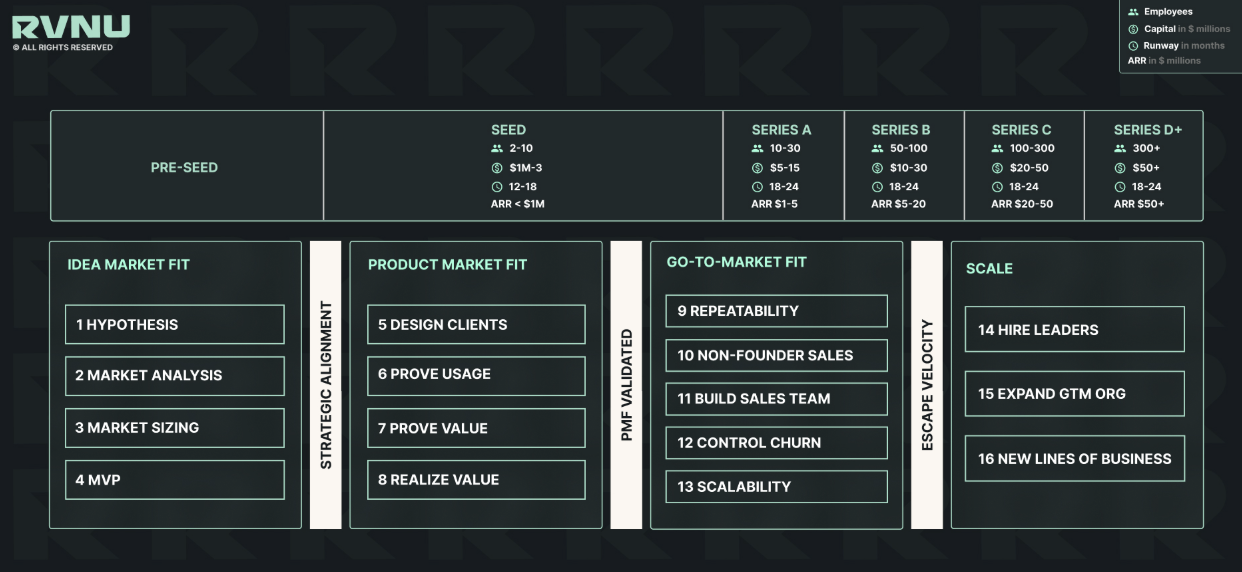
The RVNU 16-Stage Framework: Your North Star
To solve this, you need a system. Not guesswork.
Our 16-stage GTM framework maps the full journey from early validation to scalable growth across four phases: Idea Market Fit, Product Market Fit, Go-to-Market Fit, and Scale. It helps companies identify where they actually are versus where they think they are.
Within the Product Market Fit phase specifically, PMF is a progression through four stages:
- Design Partners. Onboard initial customers fitting your ICP who collaborate and provide detailed feedback.
- Prove Usage and Adoption. Confirm that key stakeholders (end users, champions, and economic buyers) actively use the product and its most valuable features.
- Prove Value. Quantify the benefits your product delivers in monetary terms. Measurable outcomes, not anecdotes.
- Realize Value. Negotiate contracts that capture a fair share of the value delivered, typically 10-20% of the quantified benefits. This confirms the economic viability of your ICP.
Across 200+ B2B SaaS companies we've assessed, only 8% get customer selection right at the Design Partner stage. And only 11% validate commercially at the Realize Value stage.
Most founders are reasonably good at getting customers to adopt and use the product. But that's often because early customers were hand-held through onboarding or weren't truly representative of the ICP. Proving repeatable value realization with the right customers is where things break.
What Actually Defines the Best GTM Consultant for Enterprise PMF?
If you're searching for the best GTM consultant for enterprise PMF, you need to rethink what "best" actually means.
Most consultants optimize for growth. Enterprise PMF is about validation.
The real distinction isn't whether a consultant focuses on leads, CAC (cost to acquire customer), or CRM database workflows. Strong consultants can contribute across all of those. The distinction is whether they're equipped to work upstream of execution. That means validating who the right customers are, whether the product delivers consistent value, and whether that value is commercially repeatable.
Enterprise PMF requires a system for proving that your product consistently delivers measurable value to the right customers, and that this can be repeated without founder involvement.
Why Most GTM Consultants Fall Short
Demand gen, RevOps, and sales execution all matter. The problem isn't any one of these disciplines. The problem is what happens when they operate in a vacuum.
Demand Generation-Focused Firms
Great at driving pipeline and optimizing acquisition channels. But pipeline without validated PMF just accelerates spend against unproven assumptions. You need demand gen. You need it pointed at the right customers.
RevOps and Systems Consultants
CRM structure, automation, and reporting are foundational. But clean dashboards don't tell you whether the underlying product is actually working for the ICP. RevOps makes the machine run. Someone still has to confirm the machine is pointed in the right direction.
Full-Service Marketing Agencies
Messaging, positioning, and execution help you tell your story. But optimizing how the product is presented before confirming it delivers real value to the right buyers puts the cart before the horse.
Each of these disciplines is essential to a functioning GTM engine. But in isolation, none of them answers the question that comes first: do we actually have enterprise PMF? Without that answer, every other investment is a bet on an unvalidated foundation.
RVNU: Built Specifically for the Enterprise PMF Problem
Most B2B software companies between $1M and $20M don't have a sales problem. They have a systems problem.
They try to scale before selecting the right customers, proving consistent usage, demonstrating measurable value, and validating willingness to pay. This leads to wasted spend, broken pipelines, and failed hires. We see it in over 100 founder conversations annually.
68% of founders fail the transition from founder-led sales to their first sales hire. Not because they picked the wrong person. Because the playbook wasn't ready, the onboarding didn't exist, and they delegated before the system was built.
RVNU was built to fix this. We combine revenue leadership, sales execution, and RevOps into a single system. That means we diagnose what's blocking growth and execute the scope to drive it. Not one or the other. Both.
Our Approach
We use a 16-stage GTM framework to systematically validate ICP accuracy, usage consistency, value realization, and commercial viability. The framework is circular, not linear. When companies launch new product lines, Stage 16 returns to Stage 1. Nine stages require fresh validation. Seven can be inherited.
The diagnostic tells you where you are. The engagement fixes what's broken and builds what's missing. Demand gen, RevOps, sales process, hiring, onboarding. All of it, sequenced correctly against where you actually are in the framework.
Our Track Record
- 200+ B2B SaaS companies assessed through our GTM Debt Assessment
- 18+ GTM engagements across software verticals
- Deep focus on enterprise PMF and pre-scale validation
Best For
B2B SaaS companies that need to validate enterprise PMF before hiring sales teams, scaling outbound, or increasing GTM spend. And companies that need a partner who can execute once the diagnosis is clear.
How to Choose the Best GTM Consultant for Enterprise PMF
Before hiring anyone, answer one question: are you validating, or scaling?
Most founders at this stage believe they're ready to scale. The Series A is closed. Investors expect growth. The pressure to hire and execute is real. But if you're still figuring out who your ICP actually is, whether customers consistently use your product, whether they achieve measurable outcomes, and whether they're willing to pay for that value, then scaling will accelerate the problem. It won't solve it.
The instinct to move fast is understandable. But the cost shows up later. Stalled revenue growth. Broken pipelines. The slow realization that the foundation was never solid.
Red Flags to Avoid
One-size-fits-all playbooks. Enterprise PMF is highly contextual. Generic SaaS playbooks fail here.
Promises of quick wins. Enterprise validation takes time. Anyone over-promising speed is skipping stages. And skipping stages is exactly how GTM Debt accumulates.
Starting with channels instead of customer value. If the first conversation is about demand gen tactics and not who your customer is and what value they get, you're solving the wrong problem.
The ROI of Getting This Right
When enterprise PMF is validated, sales becomes repeatable. CAC becomes predictable. Expansion revenue increases. Hiring gets easier because the system, not the founder, carries the motion.
When it's not validated, everything feels harder than it should.
Taking Action: Validate Before You Scale
If you're searching for the best GTM consultant for enterprise PMF, the answer isn't just about who you hire. It's about whether you're solving the right problem first.
Start with a diagnostic. Our GTM Debt Assessment at gtmdebt.com gives you an objective read on where you actually are across all 16 stages. No sales pitch. No playbook. Just an honest assessment of where the gaps are and what to do about them.
Because scaling doesn't fix broken foundations. It amplifies them.
FAQ
How do I choose the best GTM consultant for enterprise PMF?
Start with a diagnostic, not a playbook. If PMF isn't fully proven, prioritize consultants who focus on customer selection, value validation, and repeatability before growth execution. You want an objective read on where you are. Not confirmation of where you think you are. Take the GTM Debt Assessment to get that baseline.
How do I know if I actually have product-market fit?
You've proven value with multiple enterprise customers fitting your ICP. They consistently use the product, achieve measurable outcomes, and you've captured fair pricing for the value delivered. And you can repeat this beyond your initial network. That's Realize Value, Stage 8 in our framework. Most companies think they're there when they're still at Stage 6 or 7.
How long does enterprise PMF take?
It depends on your starting point, ICP complexity, sales cycle length, and how quickly you can run validation cycles. There's no shortcut. Rushing this stage is one of the most common and costly mistakes we see.
Should I hire a consultant or build internally?
Start with the diagnostic. Run an honest assessment of where you are across customer selection, usage consistency, value realization, and commercial validation. If that surfaces clear gaps in the PMF stages, you likely need outside expertise. Not a generalist who hands you a playbook. Someone who meets the criteria above. If the diagnostics confirm you're further along than you thought, build internally. The sequence matters: understand the problem, then decide who solves it. Start at gtmdebt.com.
Author

For weekly RVNU growth insights, subscribe to our Substack newsletter
Join over 2,000 subscribers!