
The Best Fractional CRO for Enterprise Series A/B Startups (And Why Most Founders Get This Wrong)
The Best Fractional CRO for Enterprise Series A/B Startups (And Why Most Founders Get This Wrong)
You've hit a ceiling.
Your self-serve or mid-market motion is working. Revenue is growing. But the deals you actually want, the ones with $50K+ ACVs and multi-year terms, keep stalling. Procurement gets involved. Champions go quiet. Sales cycles stretch past anything your current playbook was built for.
So you start looking for a revenue leader. Maybe a fractional CRO. Maybe a full-time VP of Sales. The board is pushing. Your investors have opinions. Everyone has a candidate.
The problem is that most revenue leader hires at this stage fail. Not because the people are bad. Because the system isn't ready for the transition they're being asked to make.
What Enterprise Actually Means
Enterprise isn't defined by the size of the organization you sell to. It's defined by the ticket price of the deal.
At $50K+ ACV, the deal becomes a strategic investment for the buyer. That changes everything. Multiple buying influences need to vet the decision. Economic buyers, technical stakeholders, end users, procurement. Implementation has outsize organizational impact, which means logistical complexity that doesn't exist in smaller deals. Combined, this creates sales cycles that run multiple months and require a fundamentally different motion than what got you to this point.
Your ICP shifts. The buyer's priorities, risk tolerance, and evaluation process are different. Your messaging and positioning need to reflect that.
Your value proof must be quantifiable. Enterprise buyers don't purchase on demos. They purchase on measurable business outcomes articulated in dollar terms.
Your pricing gets more complex. Flat-rate or seat-based models that worked at mid-market often break at enterprise. The pressure to consider consumption-based pricing, particularly for AI-native products, adds another layer. Contracts should capture 10-20% of quantified value delivered. If pricing is still ad hoc, you don't have a repeatable commercial motion.
Your RevOps needs to mature. Managing 20 enterprise opportunities at different stages with different champions and risk profiles requires real infrastructure. CRM becomes the system of record. Forecasting accuracy matters.
Your customer success motion changes. Enterprise customers expect dedicated support and proactive engagement. Churn at this tier compounds. You lose revenue and you lose the references that unlock the next enterprise deal.
Most revenue leaders are strong at one or two of these dimensions. Enterprise GTM is a system. All of them need to work together.
Why Most Revenue Leader Hires Fail at This Stage
When Series A/B founders look for a fractional CRO or VP of Sales to lead an upmarket move, the failure patterns are fairly consistent.
They bring a playbook from a different context. The playbook that worked at a $50M company selling horizontal SaaS to mid-market doesn't transfer to a $5M company selling vertical software to enterprise. Enterprise GTM is highly contextual. Generic playbooks fail.
They focus on one function in isolation. A revenue leader who only knows sales will optimize the sales process without validating whether the enterprise ICP is right or whether value is being proven. Revenue leadership, sales execution, and RevOps all need to work together. In isolation, none of them solve the problem.
They skip the diagnostic. The most expensive mistake in an upmarket transition is scaling a motion that isn't validated. Before anything else, you need to know which stages of enterprise validation you've completed and which you've skipped. A revenue leader who starts with tactics before answering these questions is building on assumptions.
They don't have enterprise buying experience. Pattern recognition matters. Navigating multi-stakeholder buying committees, procurement, and value-based pricing negotiations is a muscle that takes years to build. Startups don't have years. These hires have weeks to make an impact. If your revenue leader is developing enterprise selling instincts for the first time in your business, the learning curve will outlast your runway.
Where Moving Upmarket Needs System not a Playbook
In our 16-stage GTM framework, moving upmarket is effectively launching a new line of business (Stage 16), which sends you back to Stage 1 for the enterprise segment. Nine stages require fresh validation. Seven can be inherited from your existing motion.
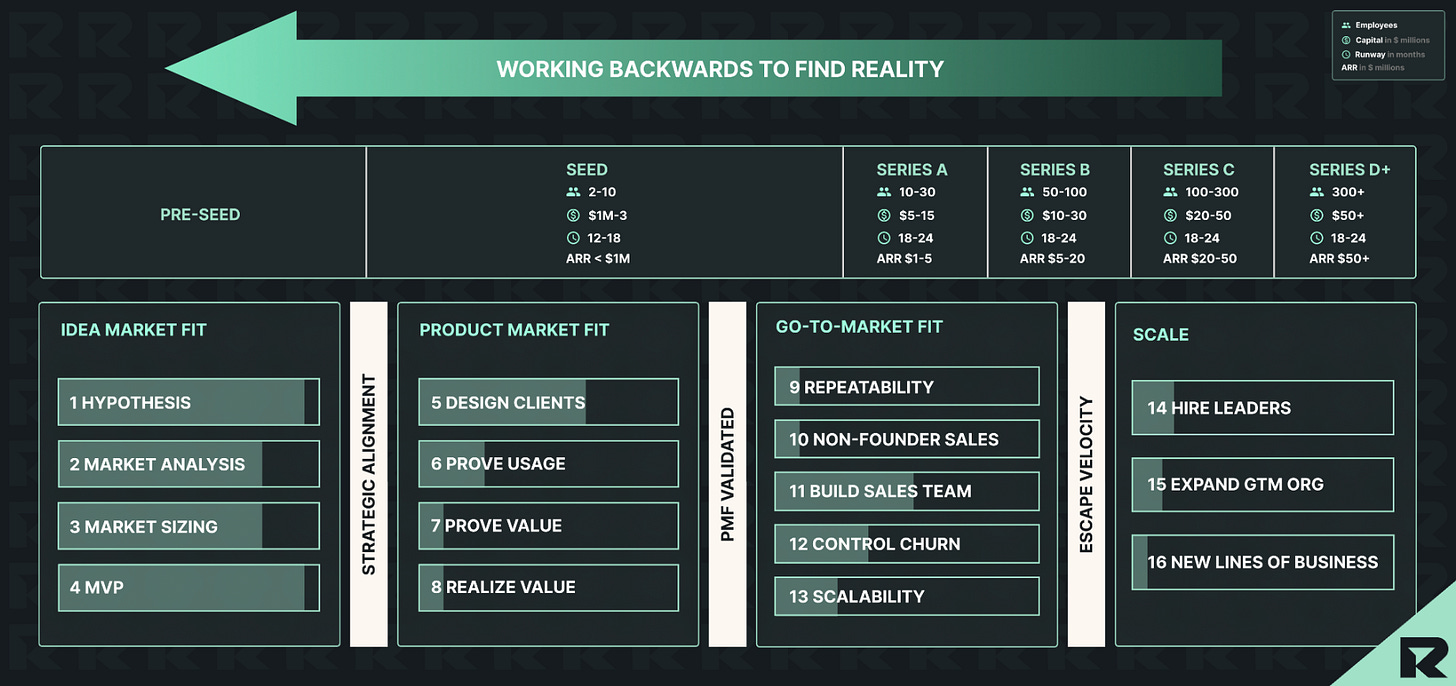
The critical path runs through the Product Market Fit and Go-to-Market Fit phases:
- Stages 5-8 (Design Partners through Realize Value): Re-validate your ICP for enterprise, prove usage across all three buyer personas, quantify value in dollar terms, and capture that value in pricing.
- Stages 9-13 (Repeatability through Scalability): Prove the enterprise motion works beyond your first few deals. Document the playbook. Validate that non-founders can sell it. Build the team. Control churn. Prove unit economics hold.
Demand generation isn't a late-stage concern. It starts at Stage 9 with repeatability and builds through the Go-to-Market Fit stages. If you can't generate enterprise pipeline repeatably, hiring enterprise reps makes the problem more expensive, not smaller.
Skip a stage and you create GTM Debt in the enterprise segment that compounds with every deal you force through an unvalidated motion.
What to Look For in a Revenue Leader for This Transition
A diagnostic-first approach. They should assess where you actually are before recommending any action. If the first conversation is about pipeline tactics or tech stack, they're starting in the wrong place.
Cross-functional capability. Enterprise GTM requires revenue leadership, sales execution, and RevOps working together. A fractional CRO or VP of Sales who only brings one of these creates gaps the other two have to fill.
Enterprise selling experience. Not adjacent to enterprise. In enterprise. They should know the difference between enterprise sellers and commodity sellers. Enterprise sellers go high in organizations, sell to strategic influencers, and defend value-based pricing. Commodity sellers go low, focus on features, and compete on price. If they can't assess which your team has, they can't build what you need.
A clear point of view on sequencing. Enterprise GTM work has a correct order. The right partner can articulate what happens first, second, and third, and explain why each step depends on the one before it.
A path to independence. The engagement should build internal capability. Documentation, knowledge transfer, systems that your team owns. If the model requires permanent outside involvement, the incentives are misaligned.
How RVNU Approaches Enterprise GTM Transitions
RVNU works with B2B SaaS companies between $1M and $20M ARR. We combine revenue leadership, sales execution, and RevOps into a single system. We diagnose what's blocking growth and execute the scope to drive it.
Every engagement starts with the GTM Debt Assessment. We map where you actually are across all 16 stages, identify gaps in your enterprise validation, and build a sequenced plan based on what the data says.
We operate at two tiers: Advisory for strategic guidance and Co-Pilot for embedded fractional execution. Both are built to fix what's broken and build what's missing. ICP validation, sales process, value articulation, pricing, RevOps infrastructure, team composition, onboarding. All of it, sequenced against where you actually are in the framework.
The goal of every engagement is to make RVNU unnecessary. We build the systems, document the playbooks, and transfer the knowledge so your team owns it.
200+ B2B SaaS companies assessed. 18+ GTM engagements across software verticals. See how this works in practice in our case studies.
Taking Action
Start with the diagnostic. Our GTM Debt Assessment at gtmdebt.com gives you an objective read on where you are across all 16 stages, including how ready you are for an enterprise transition. No sales pitch. Just an honest assessment of where the gaps are and what to fix first.
FAQ
Do I need a fractional CRO or a full-time VP of Sales to move upmarket?
The title matters less than the capability. You need someone who can diagnose where your enterprise validation gaps are, sequence the work, and execute across revenue leadership, sales, and RevOps. At Series A/B, a full-time CRO is typically premature. A VP of Sales is right when you have a validated, repeatable enterprise motion to scale. Before that, you're asking someone to build the foundation and run it simultaneously. Take the GTM Debt Assessment to understand what you actually need before committing.
How long does an enterprise transition take?
If you're starting from scratch with a new enterprise ICP, expect 6-12 months on Stages 5 through 9 before the motion is repeatable. Companies that try to compress this timeline accumulate GTM Debt that shows up as stalled deals, high churn, and failed hires.
Can I run mid-market and enterprise motions simultaneously?
You can, but they're different systems. Different ICPs, different sales processes, different value stories, different pricing, often different teams. The framework is circular. Moving upmarket sends you back to Stage 1 for the enterprise segment. Nine stages require fresh validation. Seven can be inherited.
What's the biggest risk of moving upmarket too early?
Accumulating GTM Debt in a new segment before the existing motion is solid. If you scale an enterprise sales motion before validating the ICP, proving value, and building the playbook, every hire and every campaign is built on assumptions. Unwinding an enterprise motion that was built wrong is significantly more expensive than building it right the first time.
Author

For weekly RVNU growth insights, subscribe to our Substack newsletter
Join over 2,000 subscribers!