
How to Scale Beyond Founder-Led Sales: The Complete 2026 Guide
.jpg)
The moment you close your Series A, the rules change.
You've spent the last two years proving the product works. Selling it yourself. Closing every deal. Knowing every customer by name. Now investors expect you to build a machine that does what you've been doing. Without you in every room.
I talk to over 100 founders a year who are navigating this exact moment. The ones who succeed don't hire their way out of founder-led sales. They build their way out. The ones who fail almost always made the same mistake: they skipped steps.
Why Series A Changes Everything
Series A is the bridge between validation and scale. You've proven product-market fit. You've demonstrated early traction. Now the expectation is that you can systematize what got you here.
That's a fundamentally different problem than selling.
At $3M+ ARR, you are no longer a salesperson. You are a sales leader. And if every deal still requires the CEO to close it, you have a revenue scaling bottleneck.
The stakes are real. Our research shows 68% of founders fail the transition from founder-led sales to their first sales hire. Not because they hired badly. Because the system wasn't ready for anyone other than the founder to run it. Based on our assessment data across 200+ B2B SaaS companies, the failure patterns are remarkably consistent: founders hire before the playbook is ready, hire the wrong profile, delegate too quickly, or underestimate what effective onboarding requires.
The Fatal Flaw: Hiring Before Systems
The most common instinct after raising a Series A is to hire a VP of Sales or CRO. Hand them the keys. Step back. Let’s be honest, venture capitalists have championed this playbook for years, so it’s no surprise founders try and execute on it.
It almost never works at this stage.
The problem isn't the quality of the hire. It's the absence of transferable systems. If the process that built your company is invisible, undocumented, and lives entirely in your head, you aren't scaling a business. You're setting up an expensive failure.
Most founder-led sales success contains invisible advantages that don't transfer. Prospects respond differently to a founder's outreach than to an unknown AE. Founders answer product roadmap questions with authority. They make pricing decisions on the spot. They carry credibility from being the person who built the thing.
When founders don't recognize how much of their success depends on these intangible factors, they set their first hire up to fail. That's not a people problem. It's a systems problem. And it's a specific form of GTM Debt: the compounding cost of undocumented processes and skipped validation steps that accumulate interest over time.
The RVNU 16-Stage Framework for Scaling Beyond Founder-Led Sales
Our 16-stage GTM framework maps the full journey from early validation to scalable growth, organized into four phases: Idea Market Fit, Product Market Fit, Go-to-Market Fit, and Scale.
The transition from founder-led sales doesn't happen at one stage. It's a progression that spans multiple stages, primarily across the Product Market Fit and Go-to-Market Fit phases. But the foundation for a successful transition is laid much earlier.
Here's how the framework applies to elevating beyond founder-led sales.
Stages 1-4: Idea Market Fit (Hypothesis, Market Analysis, Market Sizing, MVP)
These stages validate that the problem is real and the market is worth pursuing. For the founder-led sales transition, what matters here is whether the founding team built conviction on validated data or on gut feel.
If your hypothesis was never pressure-tested, your market was never properly sized, or your MVP was built without real customer input, those gaps show up later when you try to hand the sales motion to someone who doesn't have your intuition. They need data. If you skipped it, you're asking them to sell on faith.
We cover each of these stages in depth in our Startup MBA lecture series: Hypothesis, Market Analysis, Market Sizing, and MVP.
Stages 5-8: Product Market Fit (Design Partners, Prove Usage, Prove Value, Realize Value)
This is where most founders think they're done. They have customers. Revenue is growing. But PMF is a progression through four stages, not a single event.
Stage 5: Design Partners. Your earliest customers should fit your ICP and provide detailed feedback. If your early customers were friends, favors, or anyone who'd say yes, your ICP hypothesis is untested. That makes everything downstream harder.
Stage 6: Prove Usage and Adoption. Key stakeholders within client organizations need to be actively using the product. End users, champions, and economic buyers. If only one persona is engaged, you have adoption risk that a non-founder seller won't be able to navigate.
Stage 7: Prove Value. Can you quantify the benefits in dollar terms? Measurable outcomes, not anecdotes. If the founder is the only person who can articulate value, the sales motion doesn't transfer.
Stage 8: Realize Value. Contracts should capture 10-20% of the quantified value delivered. This confirms the economic viability of your ICP. If pricing is still ad hoc or founder-negotiated, there's no playbook for anyone else to follow.
Stages 9-13: Go-to-Market Fit (Repeatability, Non-Founder Sales, Build Sales Team, Control Churn, Scalability)
This is where the founder-led sales transition lives. These five stages take you from "the founder can sell it" to "the company can sell it." The sequence is non-negotiable. Each stage validates a specific capability that the next stage depends on. Skip one, and you're building on a gap that compounds.
Stage 9: Repeatability. Prove that your product can achieve PMF with customers beyond your initial network. Document the sales process. Build the playbook. The playbook must be written before the hire, not during. If you're expecting your first sales hire to figure out messaging, qualification, and objection handling while also hitting quota, you're asking them to do two jobs at once.
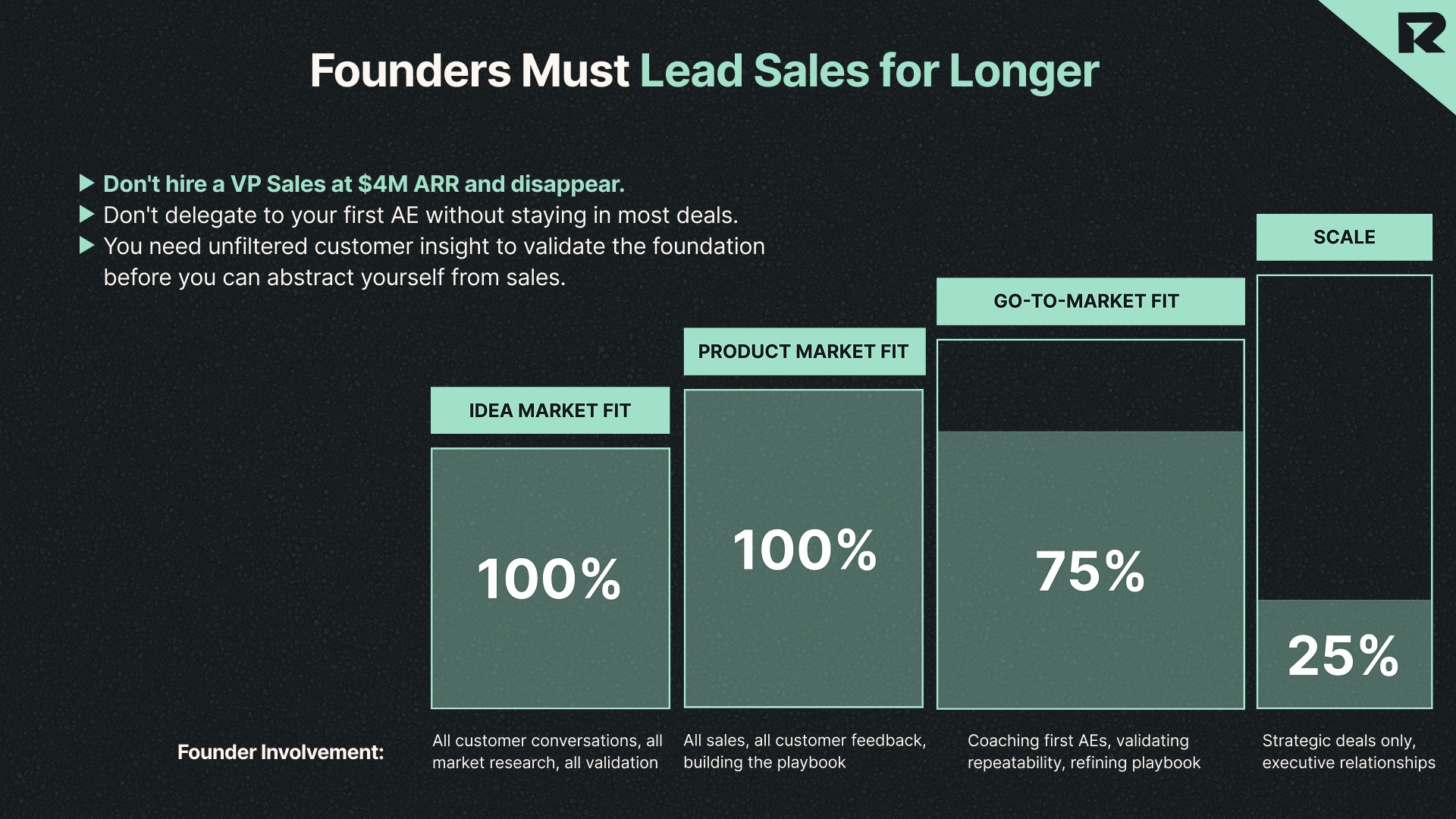
Stage 10: Non-Founder Sales. The make-or-break stage. Validate that the entire sales cycle can be executed by someone who doesn't have your founder credibility. Your first hire should be an AE, not a VP Sales. You remain the sales leader. The AE validates the playbook. Founder involvement tapers gradually: stay in 75% of deals during ramp, then reduce as the transfer proves out.
Stage 11: Build a Sales Team. Define specialized roles for lead generation, deal management, and customer retention. This isn't about adding headcount. It's about adding the right roles in the right sequence, with a documented playbook and RevOps foundation underneath.
Stage 12: Control Churn. If customers aren't successful, they leave. The goal is net revenue retention above 100%. If your churn numbers aren't solid before you scale the sales team, you're filling a leaky bucket.
Stage 13: Scalability. Prove that your unit economics hold under growth, not just at current volume. The cost structure needs to support expansion without breaking.
Stages 14-16: Scale (Hire Leaders, Expand GTM Org, New Lines of Business)
Only now do you hire the VP of Sales or CRO. The difference is everything underneath them is built.
Stage 14: Hire Leaders. Attract seasoned executives with a track record of driving revenue growth. They're stepping into a system, not being asked to build one from scratch while hitting targets.
Stage 15: Expand GTM Org. Scale the sales, marketing, and customer success teams. But prove lead scalability before adding reps. Bridge Group's 2024 benchmarks show median AE quota attainment is only 51%. Adding reps into a system that can't generate enough qualified pipeline doesn't fix the problem. It makes it more expensive.
Stage 16: New Lines of Business. The framework is circular. When you launch a new product line or enter a new market, Stage 16 returns to Stage 1. Nine stages require fresh validation. Seven can be inherited from the existing motion.
The Patterns We See Across Hundreds of Companies
After assessing 200+ B2B SaaS companies through our GTM Debt Assessment, the failure patterns in the founder-led sales transition are remarkably consistent.
The playbook doesn't exist. Founders expect the first hire to document the process while also hitting quota. That never happens. The rep focuses on closing deals. The playbook never gets written.
The founder teaches, not the system. Even when founders hire someone good, they transfer knowledge through direct coaching. Sitting in on calls. Answering questions in the moment. Providing context only they have. The rep succeeds, but the playbook didn't teach them. The founder did. This creates a scaling time bomb. When you hire rep two and three, the first rep can't teach them the same way. Tribal knowledge compounds.
The hire profile is wrong. Enterprise sellers and commodity sellers have fundamentally different DNA. Enterprise sellers go high in organizations, sell to strategic influencers, and defend value-based pricing. Commodity sellers go low, sell to users, and compete on price. Hiring for generic sales ability instead of your specific sales motion is one of the most expensive mistakes at this stage.
The founder disappears too fast. Founder involvement should taper, not stop. During Go-to-Market Fit, remain in approximately 75% of deals. Direct customer conversations are your most valuable feedback mechanism. Abstracting yourself entirely means losing the signal you need to iterate on product, messaging, and go-to-market strategy.
The companies that get the transition right share a different pattern. They build the system before the hire. They design structured onboarding programs with assessments and milestones. They stay involved long enough to validate the transfer. And they treat the transition as an engineering problem, not a hiring problem.
You can see examples of how this plays out in our case studies.
Common Pitfalls and How to Avoid Them
Hiring Too Senior Too Early
At $1M ARR, you need a doer. A founding AE who can help refine the playbook while actively selling. A VP of Sales is typically right at $3M-$5M ARR when you need to scale an existing, proven motion. Hiring a VP before the motion is proven means you're paying for leadership of a system that doesn't exist yet.
The Documentation Time Bomb
Companies that skip documentation at the Repeatability stage (Stage 9) hit an inflection point around three reps where tribal knowledge transfer breaks down completely. The founder taught rep one directly. Rep one can't teach rep two the same way. By rep three, everyone is running a different version of the sales process.
Build playbooks before the hire. Not during. Not after.
Hiring for Generic Sales Ability
If you hire commodity sellers into an enterprise motion, they will institutionalize a race to the bottom on pricing. Hire for your sales motion, not for a logo on a resume. A mid-level AE with the right sales motion experience will outperform a senior rep from the wrong motion every time.
Taking Action: Validate Before You Scale
The transition from founder-led sales isn't about when you stop selling. It's about when you start building the system that lets others sell.
Most founders get this backwards. They hire first, then try to build the system around the hire. The companies that succeed build the system first, then hire someone to run it.
Start with a diagnostic. Our GTM Debt Assessment at gtmdebt.com tells you exactly where you are across all 16 stages, where the gaps are, and what to fix before making your next hire.
Because the transition from founder-led sales is an engineering problem. Not a hiring problem. Treat it like one.
FAQ
How long does the transition from founder-led sales typically take?
Most companies move through Stages 9 and 10 in 6-12 months. The timeline depends on how much preparation work exists before the first hire. Companies that skip the playbook and onboarding design phase don't go faster. They restart.
When should I hire my first VP of Sales?
At $3M-$5M ARR, after you've proven the motion works with 2-3 AEs. Before that, you need a founding AE who validates the playbook while actively selling. Seniority matters less than fit with your specific sales motion.
How do I know if I'm ready to scale beyond founder-led sales?
If more than 80% of your closed deals required your direct involvement, you're not ready. Revisit Stage 9. If your playbook is documented well enough that a new hire could follow it without asking you questions, and you have a structured onboarding program with weekly milestones, you're closer. Take the GTM Debt Assessment to get an objective read.
What's the biggest mistake founders make in this transition?
Hiring before building transferable systems. The 68% failure rate isn't about picking the wrong person. It's about expecting the right person to succeed without a playbook, without structured onboarding, and without the founder staying involved long enough to validate the transfer.
Should my first sales hire be an SDR or an AE?
AE. You need to validate that the full sales cycle can be executed by a non-founder. SDRs only validate lead generation. If you're questioning whether you have enough pipeline to support an AE, that's a Stage 9 (repeatability) problem. Your repeatability isn't proven yet.
Author

For weekly RVNU growth insights, subscribe to our Substack newsletter
Join over 2,000 subscribers!